
Fintech hiring is harder than it looks. Candidates need technical fluency and regulatory literacy — AML, KYC, data governance, state licensing. Generic tech recruiters routinely miss the second half of that equation, presenting technically capable candidates who have never operated inside a regulated environment.
This list focuses on firms that specialize in exactly that intersection.
TL;DR
- Fintech candidates must combine technical skills with compliance knowledge — a combination that's rare and increasingly scarce.
- The most in-demand 2026 roles span AI engineering, compliance, risk, and financial product management — all requiring sector-specific recruiter expertise.
- Selection criteria: US market presence, fintech specialization depth, engagement model flexibility, and a track record in regulated industries.
- Match the firm to your vertical (payments, regtech, lending) and your hiring stage — contingent for mid-level, retained for CCO or CRO searches.
- Top firms for 2026: Wayoh, Storm2, Selby Jennings, Talentfoot, Redfish Technology, and Bowdoin Group.
Fintech Recruitment in 2026: Why Specialization Matters
A fintech recruitment firm does something a generalist tech recruiter cannot: it evaluates candidates on regulatory competence, not just technical output. Placing the wrong person in a Chief Compliance Officer or BSA Officer role isn't just a hiring miss — it's a regulatory liability.
The Regulatory Layer Has Gotten Thicker
The compliance hiring environment in 2026 is significantly more complex than it was five years ago:
- 20 US states now have comprehensive consumer data privacy laws in effect
- AML and KYC programs require real-time transaction monitoring and biometric verification
- Banking-as-a-Service sponsors are now held directly accountable for their fintech partners' compliance failures
- 31% of finance job postings now require AI or machine learning skills, up from 25% a year earlier — and entirely new roles like AI Model Risk Manager and AI Governance Officer are being actively recruited
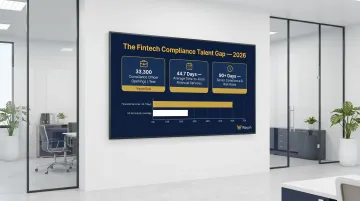
That regulatory complexity is outpacing available talent. The US Bureau of Labor Statistics projects 33,300 compliance officer openings per year through 2034, and supply is not keeping pace. Financial services already averages 44.7 days to fill a role — nearly 28% longer than the US all-industry average — and senior compliance or risk roles frequently exceed 90 days.
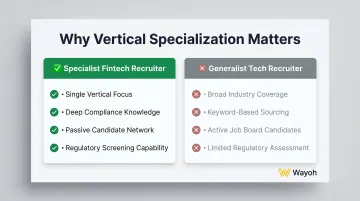
Generalist recruiters source from job boards and run keyword searches. Specialized fintech recruiters maintain deep networks of compliance and risk professionals, many of whom are never actively applying anywhere.
Top Recruitment Firms for Financial Technology in 2026
These firms were selected based on fintech specialization depth, US market presence, engagement model flexibility, and demonstrated success placing candidates in compliance, risk, legal, and technical fintech roles.
Wayoh Financial Services Recruiting
Wayoh has over a decade of experience in financial services staffing, with 500+ professionals placed across banking, fintech, and healthtech. The firm built its foundation in traditional banking — community, commercial, and investment banks — before expanding into fintech and healthtech as client needs evolved. Active markets include New York, California, Florida, Texas, and Chicago.
The firm's relationship-led model is purpose-built for regulated environments. Rather than relying on database searches or job board sourcing, Wayoh's recruiters draw on direct personal networks to surface passive candidates — professionals who aren't responding to job postings but are open to the right conversation.
This approach consistently produces stronger shortlists for compliance, AML, KYC, financial crime, and risk roles where the candidate pool is already thin.
The firm covers the full regulatory stack fintech hiring managers care about: AML/BSA, KYC, sanctions, transaction monitoring, customer due diligence, data governance, and FDIC compliance.
Interim consultants are fully vetted with references and background checks before introduction. Weekly check-ins during temporary placements catch performance issues before they become retention problems.
| Category | Details |
|---|---|
| Focus Areas | Compliance, risk, AML/KYC, financial crime, legal, banking, fintech, healthtech |
| Engagement Models | Temporary staffing, permanent placement, retained executive search |
| Best For | Regulated US fintech and banking firms hiring in compliance, risk, and legal functions |
Storm2
Founded in August 2019, Storm2 operates as a fintech-only recruitment agency with offices in London and New York. The firm serves 678+ clients and focuses on Series A+ placements across payments, lending, wealthtech, and blockchain. Its New York office, opened in 2022 at One World Trade Center, anchors its US market activity.
The model is built around deep vertical specialization: every consultant covers a single fintech sub-sector and a single functional area. A client hiring a payments compliance lead works with a recruiter whose entire practice is payments compliance — not a generalist covering whatever came in that week. Storm2 guarantees first candidate delivery within 72 hours and offers a 90-day sliding rebate or free replacement. Their annual fintech salary guides are genuinely useful for offer benchmarking.
| Category | Details |
|---|---|
| Focus Areas | Payments, lending, wealthtech, blockchain, open banking |
| Engagement Models | Standard, exclusive, and partnership tiers |
| Best For | Venture-backed fintech startups scaling senior teams post-funding |
Selby Jennings
Part of Phaidon International with 20+ years in the market, Selby Jennings runs a dedicated fintech practice covering payments, digital banking, trading technology, blockchain, risk, and compliance across mid-to-senior levels. The firm is particularly well-positioned at the intersection of quantitative finance and technical skill — a combination that matters for roles like Head of Model Risk or Quant Risk Manager.
Their Global Financial Technology Compensation Guide — covering the US, Europe, and Asia-Pacific — is a useful resource beyond just the placement service, giving hiring managers a real benchmarking tool for offer construction.
| Category | Details |
|---|---|
| Focus Areas | Payments, trading tech, risk, compliance, digital banking |
| Engagement Models | Permanent, contract, retained, multi-hire solutions |
| Best For | Mid-to-senior fintech hiring at scale, especially risk and compliance roles |
Talentfoot
Founded in 2010 and headquartered in Chicago, Talentfoot is a boutique executive search firm with fintech practice coverage across payments, digital banking, regtech, insurtech, lending, and embedded finance. The firm takes a consulting-first approach — every engagement begins with a deep dive into the company's technology stack, growth trajectory, and cultural fit before any candidate sourcing begins.
Engagements include psychometric testing and executive coaching, which differentiates Talentfoot from firms that treat executive search as transactional. Their retained model suits post-funding companies that need to get C-suite hires right the first time.
| Category | Details |
|---|---|
| Focus Areas | Digital banking, payments, regtech, lending, insurtech, wealthtech |
| Engagement Models | Retained, engaged, and contingent search |
| Best For | Post-funding fintech companies seeking C-suite and senior executive placements |
Redfish Technology
Founded in 1996, Redfish Technology brings nearly three decades of US tech recruiting experience to fintech, with coast-to-coast coverage across data security, crypto, and broad fintech verticals. Their "Just in Time" approach emphasizes speed without sacrificing candidate quality — the firm reports delivering at least five resumes by the end of the first week and an average four-week time-to-fill for fintech roles.
Three engagement models (contingent, retained, and engaged) give clients genuine flexibility to match fee structure to urgency. The firm functions more like a strategic partner — providing onboarding guidance, industry trend data, and ongoing market analysis beyond the placement itself.
| Category | Details |
|---|---|
| Focus Areas | Broad fintech, data security, crypto, IT and software |
| Engagement Models | Contingent, retained, engaged |
| Best For | Companies needing quality fintech hires quickly with flexible fee structures |
Bowdoin Group
Bowdoin Group is a nationally recognized executive search and RPO firm with fintech practice capabilities, and Managing Director Jim Urquhart was named to Business Insider's list of top fintech recruiters. Rather than filling a single leadership seat in isolation, Bowdoin evaluates how executive hires integrate into the broader organizational structure — useful for companies that are rebuilding a leadership team, not just backfilling a vacancy.
Their RPO capabilities make them worth considering for fintech firms with larger, ongoing hiring mandates that need more than one-off search support.
| Category | Details |
|---|---|
| Focus Areas | Fintech executive leadership, C-suite, board-level roles |
| Engagement Models | Retained executive search, RPO, direct placement |
| Best For | Fintech companies building or restructuring C-suite and leadership teams |
How We Chose These Fintech Recruitment Firms
Firms were assessed across four dimensions:
- Fintech specialization depth — genuine sector knowledge across verticals like payments, regtech, and compliance, not just a financial services practice with a fintech landing page
- Documented US-market placements — confirmed activity in the US market for fintech roles, not just international presence
- Engagement model flexibility — contingent, retained, and project-based options to suit different hiring stages and budgets
- Client feedback quality — evidence of repeat business, satisfaction, and post-placement outcomes
The Common Mistake: Choosing by Brand, Not Depth
Many hiring managers default to large, well-known firms on the assumption that bigger networks mean better results. In fintech compliance and risk hiring, that assumption usually backfires.
A large generalist firm with a "fintech practice" may have a thousand recruiters and a database of 500,000 profiles. But if those recruiters cannot assess whether a candidate truly understands BSA recordkeeping obligations or how to build a transaction monitoring program from scratch, that volume produces fast submissions and thin shortlists — not strong hires.
The better question to ask any recruiter is: Can you tell me about the last Chief Compliance Officer you placed in a Series B payments company? The answer will tell you immediately whether you're talking to a specialist or a generalist with a fintech landing page.
Matching Engagement Model to Role Seniority
Not every search warrants retained engagement — but some clearly do:
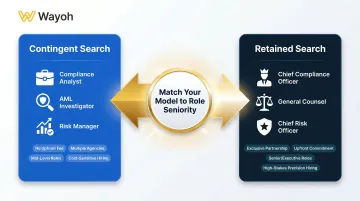
- Contingent search works well for mid-level roles (Compliance Analyst, AML Investigator, Risk Manager) where there's reasonable candidate availability and cost control matters
- Retained search is worth the upfront commitment for Chief Compliance Officer, Chief Risk Officer, or General Counsel searches — roles where a bad hire is an operational and regulatory problem, and where the best candidates won't surface through contingent sourcing
Conclusion
Fintech recruitment in 2026 is a specialist discipline. The regulatory environment is complex, the talent pool is tight, and a wrong hire in compliance or risk costs more than time — it creates regulatory exposure.
When evaluating recruitment partners, look past brand recognition. The right questions to ask:
- What's their track record in your specific vertical?
- How familiar are they with the regulatory frameworks your candidates need to know?
- Does their engagement model match your timeline?
For fintech and banking companies hiring in compliance, risk, or legal functions across New York, California, Florida, Texas, or Chicago, Wayoh's relationship-led model and decade-plus of regulated industry experience are built for exactly this work. Reach out to info@wayoh.co to talk through your compliance, risk, or legal hiring priorities.
Frequently Asked Questions
What are the top recruitment agencies placing sales talent in fintech?
Storm2, Selby Jennings, and Talentfoot all cover fintech sales roles, with typical placements spanning GTM leaders, business development, and account executives for payments and digital banking companies. Look for firms with explicit go-to-market practice coverage, not just general fintech placement.
Who are the best recruiters for customer success in fintech startups?
Storm2 and Redfish Technology both place customer success professionals within fintech. Startup-focused recruiters who understand fintech product complexity are best positioned here, since CS roles in regulated environments require both financial services knowledge and technical support depth.
Who are the Big 5 recruiting firms?
The traditional Big 5 in executive search are Korn Ferry, Spencer Stuart, Heidrick & Struggles, Russell Reynolds Associates, and Egon Zehnder. They serve large enterprises well but operate fintech as a sub-specialization within broader financial services practices — not as dedicated fintech specialists with deep compliance and risk candidate networks.
How do you evaluate the effectiveness of your recruitment strategies?
Track time-to-fill, offer acceptance rate, 90-day retention, and quality-of-hire scores. Specialized fintech recruiters typically provide structured post-placement check-ins that make these metrics easier to monitor and benchmark against industry norms.
What types of roles do fintech recruitment firms typically fill?
Coverage spans C-suite (CTO, CFO, Chief Compliance Officer), technical roles (software engineers, data scientists, AI/ML specialists), compliance and risk professionals, product managers, and sales and business development talent. The depth of coverage in any specific category varies significantly by firm.
What makes fintech recruitment different from general tech recruiting?
Fintech hires often need working knowledge of AML requirements, KYC workflows, data governance frameworks, and compliance program design — not just technical credentials. Generalist tech recruiters typically lack the domain knowledge to screen for these requirements, which leads to shortlists that look qualified on paper but underperform in practice.