
According to FinCEN's FY2024 Year in Review, Money Services Businesses filed 1.45 million SARs in FY2024 alone — and enforcement penalties have reached historic levels. The stakes for getting AML staffing wrong have never been higher.
This article breaks down the five hiring trends reshaping fintech AML teams in 2026, the structural forces behind them, and what compliance leaders should be planning for now.
TL;DR
- Fintech AML hiring is surging in 2026, driven by enforcement escalation and expanding product complexity
- Top candidates combine BSA/AML knowledge with hands-on RegTech and AI monitoring experience
- Crypto and DeFi AML specialists are among the hardest roles to fill in the current market
- Series B+ fintechs are shifting from outsourced compliance to designated, full-time BSA Officers
- Contract and interim AML hiring is rising as fintechs race to close program gaps before regulatory examinations
5 Key AML Hiring Trends Reshaping Fintech in 2026
Trend 1: Hybrid Tech-Compliance Profiles Are the New Standard
Fintech employers have moved well past hiring for regulatory knowledge alone. Today's AML analyst job briefs routinely require hands-on experience with AI-powered transaction monitoring platforms — tools like Actimize, Sardine, and Unit21.
Candidates also need the ability to tune monitoring rules, build risk-scoring logic, and write defensible SAR narratives.
This creates a meaningful compensation premium. Glassdoor data shows AML Compliance Analysts averaging $96,834, compared to the BLS median of $78,420 for compliance officers broadly — a 23% gap that reflects AML specialization. Candidates who can both configure monitoring systems and produce investigation-quality SARs command salaries at the top of that range and beyond.
The practical hiring challenge: neither talent pool is plug-and-play.
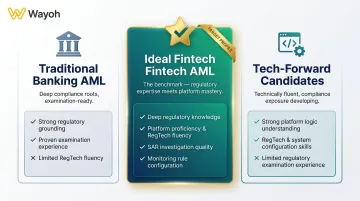
- Traditional banking AML professionals bring regulatory grounding but often lack fluency with modern RegTech tools
- Tech-forward candidates may understand platform logic but have no regulatory examination experience
- Fintech AML roles require both — and the overlap is narrow
ACAMS has responded by launching the Certified AML FinTech Compliance Associate (CAFCA) credential, formally acknowledging that fintech AML competency is its own discipline. Employers are using it as a screening signal — not a requirement, but a differentiator that filters for candidates who've invested in the crossover.
Trend 2: Crypto and DeFi AML Specialists Are the Hardest Roles to Fill
Crypto AML has crossed from niche specialty into a full-scale hiring shortage. FinCEN's classification of crypto platforms as MSBs, combined with landmark enforcement actions, has created structured demand for professionals who understand blockchain transaction analysis, on-chain monitoring tools (Chainalysis, Elliptic), and crypto-specific SAR typologies.
FinCEN's action against Binance resulted in a $3.4 billion civil money penalty — the largest in U.S. Treasury history. The December 2025 Paxful case added another $3.5 million FinCEN penalty, with DOJ reaching a separate $4 million resolution. Paxful facilitated over 26.7 million trades worth nearly $3 billion while lacking adequate compliance staff.
The DeFi layer compounds the challenge:
- No clear regulatory playbook exists for decentralized protocol compliance
- Candidates need both regulatory interpretation skills and protocol-level understanding of smart contracts
- The supply of professionals who have both is small
Most fintechs filling these roles today are making trade-offs — either hiring regulatory professionals and investing in crypto upskilling, or bringing in crypto-native talent and providing compliance grounding. Neither path is fast. ACAMS has introduced the Certified Cryptoasset Anti-Financial Crime Specialist (CCAS) to address this gap, but the credential market is still catching up to employer demand.
Trend 3: In-House BSA Officers Are Replacing Outsourced Compliance Models
For several years, early-stage fintechs managed BSA/AML obligations through fractional CCO arrangements or by leaning on their bank sponsor's compliance infrastructure. Regulatory pressure has made that model unsustainable.
The FDIC's 2024 consent orders against Blue Ridge Bank, Choice Bank, Evolve Bank & Trust, Lineage Bank, and Cross River Bank all cited BSA/AML deficiencies tied to fintech partnerships. Requirements imposed included four-year CIP lookbacks, two-year SAR lookbacks, and independent program testing — work that cannot be delegated to a part-time consultant or absorbed by a banking partner.
Fenwick's May 2025 analysis confirms that fintechs operating as MSBs must now maintain all four pillars of an effective AML program: internal controls, a designated compliance officer, ongoing training, and independent testing.
The candidate profile this creates is specific:
- Experience building BSA programs, not just maintaining established ones
- Comfort operating with board-level visibility and accountability
- Background in community bank BSA or early-stage fintech compliance builds — not just large-bank operations roles
This shift is most pronounced at Series B+ fintechs and payment companies approaching their first regulatory examination. For these companies, the designated BSA Officer hire often represents the most consequential compliance decision they'll make.
Trend 4: Contract and Interim AML Hiring Is a Structural Trend, Not a Stopgap
The speed at which fintechs launch products and onboard customers rarely aligns with the 60-to-90-day timeline required to recruit and onboard a permanent AML hire. Contract and interim staffing has become the standard solution, and the best-run teams are treating it deliberately rather than reactively.
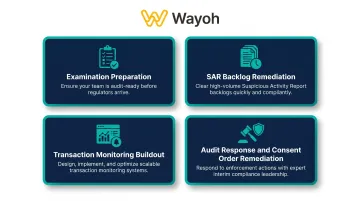
Common use cases driving interim AML demand:
- Examination preparation — covering compliance gaps before a first regulatory review
- SAR backlog remediation — clearing filing backlogs under regulatory deadlines
- Transaction monitoring buildouts — standing up alert review functions during product launches
- Audit response — supporting remediation requirements from consent orders
The FDIC consent order lookback requirements — four years of CIP records and two years of transaction and SAR records — are a good illustration of why this matters. Meeting those timelines requires bodies, not just policies. That work is typically staffed with contract analysts.
What distinguishes fintech firms that handle this well: they use contract placements strategically, not just as emergency coverage. Strong interim hires regularly convert to permanent roles. Wayoh structures contract placements with transparent conversion terms from the start, so teams can evaluate talent in a live environment before committing to a permanent hire.
Trend 5: Senior AML Program Builders Are Commanding Premium Attention
Fintech AML programs have historically been minimal — basic policies, limited testing, and risk assessments that existed more as documentation than as functioning tools. The 2024-2025 enforcement wave is ending that era.
TD Bank's 2024 OCC consent order cited deficiencies in internal controls, risk assessments, suspicious activity reporting, independent testing, and BSA Officer responsibilities — with a combined OCC and FinCEN penalty exceeding $1.2 billion. That outcome has concentrated minds in fintech boardrooms.
The hiring demand this creates is for a specific profile: AML professionals with experience surviving regulatory examinations and designing programs from scratch. Not one or the other.
Fintech verticals generating the most demand for senior program builders:
- Digital banking platforms and neobanks preparing for charter applications or first OCC examinations
- Money transmitters scaling transaction volumes without corresponding compliance infrastructure
- BaaS platforms building independent oversight functions after bank partner pressure
- Prepaid card issuers facing heightened scrutiny over KYC and transaction monitoring controls
FFIEC-aligned program design is no longer aspirational for growing fintechs. Documented risk assessments, tuned monitoring rules, and independent audit functions are the minimum standard regulators now expect to see.
What's Driving These Fintech AML Hiring Trends
Three structural forces are driving this hiring surge — and none of them are temporary.
Regulatory Escalation
FinCEN issued $3.4 billion in civil money penalties in FY2024, with the Binance settlement representing the largest Treasury enforcement action in U.S. history. FinCEN's April 2026 NPRM proposing fundamental AML/CFT program reform signals that regulators intend to hold institutions to higher standards of effectiveness — not just documentation volume.
For fintechs, this means every new enforcement action against a peer company creates internal pressure to audit and staff their own programs.
Technology Complexity
The proliferation of AI-powered monitoring tools, real-time payment rails, and crypto infrastructure has raised the technical floor for AML roles. Traditional compliance professionals cannot step directly into modern fintech AML functions without gaining fluency in transaction monitoring platforms, risk-scoring logic, and compliance technology stacks.
Talent Scarcity
According to LexisNexis Risk Solutions, US and Canadian financial crime compliance costs reached $56.7 billion in 2022 — with labor accounting for roughly 70% of total spend. The BLS projects only 3% compliance officer job growth from 2024 to 2034. Demand is expanding faster than the talent pipeline can fill it.
That gap hits hardest for hybrid tech-compliance roles, where qualified candidates rarely surface through job boards. Wayoh's candidate network — developed over 10+ years and 500+ placements across banking, fintech, and healthtech — includes passive professionals with exactly those backgrounds, the ones general sourcing consistently misses.
How These Trends Are Reshaping Fintech AML Teams
Specialist Roles Are Replacing the Generalist Model
AML teams at growing fintechs are moving away from generalist analyst models toward structured compliance operations with distinct role types. Transaction monitoring analysts, SAR specialists, and program quality reviewers now function as separate functions rather than tasks one person juggles.
This shift has direct headcount implications. A program that previously ran on two generalist analysts may now require four specialized hires to meet examination standards.
The Cost of Under-Investing in AML Talent Is Now Quantifiable
Thomson Reuters data shows the average cost of non-compliance ($14.82 million) is 2.71 times the average cost of compliance ($5.47 million). For fintechs, the additional risk is operational — losing a banking sponsor relationship or failing a regulatory examination can halt product operations entirely.
The Synapse collapse in 2024, which locked over 100,000 customers out of $265 million in deposits, shows the full cost of compliance breakdowns beyond direct penalties.
Compliance Officers Are Now in the Room Before Launch
AML leadership is no longer a back-office function. Compliance officers at growing fintechs are being included in product launch decisions, new market entries, and partnership due diligence — not brought in afterward to retrofit controls. This shift in organizational positioning is changing the seniority and scope of AML hires fintech companies are making.
Credentials Are Becoming a Baseline Requirement, Not a Differentiator
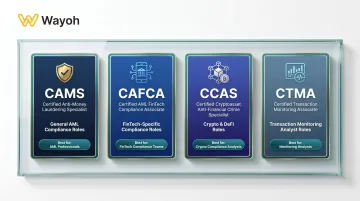
Employer job postings increasingly list CAMS, CFE, and hands-on RegTech platform experience as required qualifications. ACAMS now offers four fintech-relevant credentials: CAMS, CAFCA, CCAS, and the Certified Transaction Monitoring Associate (CTMA). That breadth reflects how specialized competency requirements have become. Candidates entering the fintech AML market without at least one recognized credential face a higher bar at screening.
Future Signals for AML Hiring in Fintech
The regulatory shifts already playing out in 2025 and 2026 point to three structural changes in AML hiring — each tied to a distinct compliance frontier fintechs will need to staff for.
AI Will Shift Analyst Roles, Not Eliminate Them
As AI automates tier-one alert triage, demand will move toward investigation-level analysis and SAR narrative work rather than volume-based alert review. FinCEN's April 2026 NPRM encourages AI-enabled compliance programs — watch for follow-on guidance on AI use in transaction monitoring as an early signal of how roles will evolve.
Stablecoin and DeFi Regulation Will Drive Crypto AML Hiring
Treasury's proposed rule implementing the GENIUS Act's requirements would subject permitted payment stablecoin issuers to full AML/CFT obligations. That creates an entirely new category of BSA-obligated entities. If DeFi rulemaking follows, the spike in crypto-specific compliance demand will be substantial.
Beneficial Ownership and KYB Will Sustain Specialized Demand
FinCEN's March 2025 interim rule significantly narrowed CTA reporting requirements for domestic entities. But fintechs onboarding business customers at scale still need professionals who understand KYB, UBO verification, and entity risk assessment — particularly as banking partners continue requiring more intensive onboarding controls.
Frequently Asked Questions
What is AML in fintech?
AML in fintech refers to the compliance framework fintech companies must follow to detect, prevent, and report money laundering — covering KYC, transaction monitoring, SAR filing, and sanctions screening under laws like the Bank Secrecy Act. Fintechs operating as MSBs carry the same BSA obligations as traditional banks.
What is the AML Foundation for FinTech?
The AML Foundation for FinTech is an educational and credentialing body offering AML training designed specifically for fintech professionals. Fintech employers increasingly value these specialized credentials alongside traditional banking certifications, as fintech compliance roles involve product types and regulatory dynamics that differ meaningfully from conventional banking.
What is the $3,000 bank rule?
The $3,000 rule is FinCEN's requirement under the Bank Secrecy Act for financial institutions to collect and retain records on funds transfers of $3,000 or more, codified at 31 CFR 1010.410. Fintech companies in payments and money transmission must operationalize this requirement, as it routinely surfaces during regulatory examinations.
What AML certifications do fintech employers look for in 2026?
CAMS (Certified Anti-Money Laundering Specialist) from ACAMS is the credential employers ask for most consistently across fintech and banking. CFE (Certified Fraud Examiner) is valued for investigation-heavy roles. ACAMS's newer credentials — CCAS for crypto and CAFCA for fintech compliance — are gaining traction with employers hiring for specialized fintech AML functions.
How competitive is the AML talent market in fintech right now?
Highly competitive, particularly for hybrid tech-compliance profiles and crypto AML specialists. Demand is outpacing the available talent pool, resulting in longer hiring timelines and upward salary pressure. Fintechs relying on general job boards typically experience slower time-to-fill compared to those working with specialized compliance recruiters.
What is the difference between AML roles at banks and fintechs?
Bank AML roles typically involve maintaining established programs within defined regulatory structures. Fintech AML roles often require building programs from scratch, adapting to novel product types like crypto and BaaS, and working with modern RegTech tooling. The scope is broader and the day-to-day work more varied than in most traditional bank positions.