The institutions that come out ahead won't just be those with the biggest hiring budgets. They'll be the ones that understand what's shifting, move faster than their competitors, and source talent proactively rather than reactively. This article breaks down the trends defining banking recruitment in 2026 and the strategies that will separate the winners from the also-rans.
TL;DR
- 87% of financial firms have adopted skills-based hiring, prioritizing demonstrated competencies over degrees
- Compliance, risk, and cybersecurity roles face persistent shortages — with tech searches averaging 48–89 days to fill
- Candidates now expect hybrid flexibility, transparent career paths, and competitive pay — firms that can't deliver these will lose offers to those that can
- Goldman Sachs projects M&A volume could reach $3.8 trillion in 2026, driving urgent mid-level hiring in deal execution
- Banks that win talent in 2026 move fast, hire proactively, and bring in specialist recruiting partners before roles become urgent
The Rise of AI-Powered Recruiting and Skills-First Hiring
From Credentials to Competencies
The shift has already happened. According to a 2025 CFA Institute report, 87% of financial firms were using skills-based hiring as of 2024 — moving away from degrees and institutional pedigree toward what one BCG Managing Director described as "will and skill." Banks are evaluating candidates on digital literacy, data fluency, adaptability, and regulatory awareness, not just where they went to school.
Credential-first screening locked out strong candidates from fintech, tech-adjacent roles, and non-traditional pathways. Skills-based models expand that pool considerably — a necessary shift, given that U.S. banking faces a projected shortage of 350,000 digital workers that recruiting alone cannot close.
AI in Recruiting Workflows
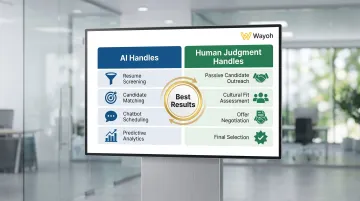
AI adoption across HR and recruiting functions jumped from 26% in 2024 to 43% in 2025 — a 65% year-over-year increase. In banking, this plays out through:
- Automated resume screening and candidate matching
- Chatbot-led initial candidate screening and scheduling
- Predictive analytics informing headcount forecasting
- Data-driven insights on talent availability by role and geography
The practical benefit is real: recruiters spend less time on administrative triage and more time on the candidate conversations that actually move searches forward. For roles where technology searches already run 48 to 89 days (SHRM 2025 benchmark), compressing early-stage screening matters.
The Risk of Over-Reliance
Those efficiency gains come with a real tradeoff. AI screening optimized for keywords and standard profile patterns tends to filter out strong passive candidates who don't fit conventional career trajectories. A compliance officer who built their expertise through fintech rather than a major bank may be exactly the hire a regional institution needs — and exactly the profile a poorly calibrated ATS screens out.
That's where the human, relationship-led element of recruiting becomes indispensable. Technology handles volume; experienced recruiters provide the judgment that separates a technically qualified candidate from the right one.
Compliance, Risk, and Cybersecurity — Banking's Most Contested Talent Pool
Why Demand Keeps Growing
Regulatory complexity isn't easing. AML obligations, evolving ESG reporting requirements, and the operational demands of digital financial services have created sustained demand for compliance officers, risk managers, fraud analysts, and cybersecurity specialists.
The BLS projects 5% growth in compliance officer roles through 2034, with approximately 418,000 positions nationally at a median salary of $78,420. That number doesn't capture the full picture — ACAMS research surveying over 1,500 anti-financial crime professionals found that "unprecedented acceleration in change" is outpacing institutional adaptation, increasing vulnerability across IT security, staffing gaps, and financial crime exposure.
Cybersecurity is where the pressure is sharpest:
| Metric | Finding |
|---|---|
| Cybersecurity professionals reporting critical skills needs | 59% |
| Organizations with at least one skill deficiency | 95% |
| Most urgent skill gap | AI security (41%) |
| Second most urgent gap | Cloud security (36%) |
| Organizations affected by hiring freezes | 39% |
Source: ISC2 2025 Cybersecurity Workforce Study
A Three-Way Competition for the Same Candidates
National banks, regional institutions, and fintech platforms are all pursuing the same compliance and risk professionals simultaneously — with meaningfully different compensation structures and cultures. Fintech firms offer 54% of professionals fully remote arrangements, and 87% offer some level of remote flexibility, compared to several major banks that reinstated five-day in-person requirements in early 2025.
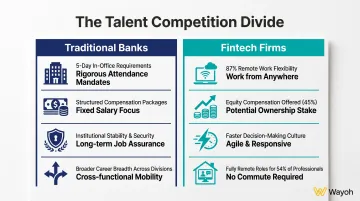
That gap in work arrangements is widening the talent divide. Specialist recruiting firms like Wayoh — focused specifically on compliance, risk, and legal placements across banking and fintech — maintain the regulatory fluency and candidate relationships to identify and reach qualified passive candidates: professionals who aren't actively job hunting but are open to the right opportunity. With 500+ placements across regulated industries over 10+ years, Wayoh's relationship-led model is designed for searches where the best candidates aren't visible on job boards.
Shifting Candidate Expectations: Pay, Flexibility, and Career Growth
Compensation Pressure Is Real
AI-augmented roles in risk advisory and credit analytics are commanding 25–35% higher compensation than the positions they're replacing. Fintech firms are raising the floor: 70% of fintech professionals received bonuses in 2025 (up from 62% the prior year), and candidates switching roles expect salary increases of 11–25%.
Meanwhile, Wolters Kluwer's 2026 banking talent report found that more than two-thirds of banks acknowledge lacking a compelling employee value proposition for digital talent. That gap is costly when competitors offer equity, remote flexibility, and faster promotion timelines as standard.
Flexibility Remains a Competitive Variable
85% of finance and insurance firms offer remote or hybrid options. 60% of professionals prefer hybrid arrangements. The banks that pushed five-day in-office requirements in early 2025 made a clear tradeoff — and some are already feeling it in candidate pipelines for tech and compliance roles.
In-office culture is a legitimate business decision. The problem is treating it as cost-free when fintech employers offering full remote work are competing for the same candidates.
What Younger Professionals Actually Want
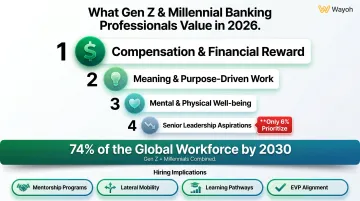
Deloitte's 2025 Gen Z and Millennial Survey (23,000+ participants across 44 countries) found that only 6% of Gen Z professionals prioritize reaching senior leadership. The primary career drivers are money, meaning, and well-being — in that order.
For banks, that reordering has direct hiring implications:
- Mentorship and skill development matter more than titles
- Lateral mobility opportunities are genuine differentiators
- Defined learning pathways outweigh vague promises of advancement
- Gen Z and Millennials will represent 74% of the global workforce by 2030 — EVPs that ignore their priorities are already behind
M&A Rebound, Sector Surges, and the Fintech Talent Overlap
The M&A Hiring Surge Is Already Underway
Goldman Sachs projects pure M&A volume could reach $3.8 trillion in 2026. PwC recorded a 45% increase in deal value through November 2025, with more than 20% of megadeals featuring an AI theme. Reuters reported that multiple bulge bracket banks have launched multi-hire campaigns at above-normal compensation levels as deal confidence returns.
Hiring demand is strongest at associate and VP levels — the professionals who execute transactions rather than just originate them. Demand clusters around TMT, healthcare, financial institutions, and private capital advisory. Banks that haven't built depth in these verticals are already losing candidates to competitors who have.
Fintech Competes Differently
That same talent pool is fielding fintech offers — and fintech employers aren't competing on base salary alone. The pitch looks different:
- Equity compensation (offered by 45% of fintech firms)
- Remote flexibility (87% offer some level of it)
- Faster decision-making environments and flatter org structures
- Fintech VC investment of nearly $3.8 billion in the first nine months of 2024, signaling growth mode
The average fintech professional earns $123,495, with blockchain developers ranging $110,000–$200,000 and information security analysts $100,000–$175,000. Banks competing for these profiles need a clear answer to that offer. What they can articulate that fintech can't:
- Institutional scale and cross-functional exposure
- Regulatory complexity as a genuine learning accelerator
- Broader career breadth across products and markets
- More predictable long-term career trajectories
Hiring Strategies Banks Need to Win in 2026
Move Faster — Seriously
In a market where top compliance, risk, and tech candidates receive multiple offers, process speed is a competitive advantage. Technology-specific searches already average 48–89 days nationally. Firms that compress that timeline through fewer interview stages, pre-approved compensation ranges, and empowered hiring managers will consistently out-hire slower competitors.
Audit your current time-to-offer metrics now. If you can't tell a candidate where they stand within a week of final interviews, you're losing searches you should be winning.
Source Proactively, Not Reactively
The best compliance, risk, and deal-execution professionals aren't refreshing job boards. They're already employed, well-compensated, and selective about when they move. Effective hiring in 2026 requires building relationships with this talent before a role opens — not launching a search from scratch the day a resignation lands.
This is the core operating model at Wayoh: a network-first approach built on direct outreach and market relationships developed over more than a decade. When a banking client needs a Chief Compliance Officer or a sanctions specialist quickly, the team isn't starting cold — they're activating existing relationships with pre-vetted professionals across markets including New York, California, and Florida.
Invest in Internal Mobility
External hiring for senior roles is expensive and slow. McKinsey's research confirms that skills-based internal mobility programs reduce dependence on external hiring while improving retention. Yet only 57% of banks that plan to reskill for AI disruption have actually created meaningful programs — a gap that most institutions haven't moved on yet.
Map your current workforce skills against projected 2026 role needs. Identify where internal talent can be developed rather than replaced.
Partner With Specialists for High-Stakes Roles
Generalist recruiters lack the regulatory fluency to source compliance, risk, and specialized banking roles. Most can't distinguish a BSA Officer from a sanctions specialist, and they don't carry relationships with passive candidates in AML or enterprise risk. When the hire is wrong, the consequences go beyond cost-per-hire — they become a regulatory and reputational problem.
Wayoh's five-stage process is built specifically for regulated environments:
- Role definition — scoping requirements against compliance and regulatory context
- Talent mapping — identifying active and passive candidates across relevant markets
- Vetted shortlisting — presenting only candidates with verified credentials and fit
- Offer management — navigating compensation and counteroffers in competitive markets
- Onboarding support — ensuring the transition holds after placement
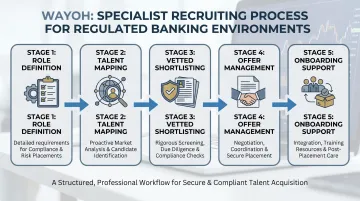
For hard-to-fill roles, specialist partnerships reduce time-to-hire, improve candidate quality, and give hiring managers better information at every stage.
Frequently Asked Questions
What are the hiring trends for banking in 2025 and 2026?
The major forces: M&A-driven demand for deal execution talent, accelerating need for compliance and cybersecurity professionals, skills-based hiring adoption, and AI integration into recruiting workflows. Regional and national banks are also competing more directly with fintech firms for technology talent than ever before.
Which banking roles are hardest to fill in 2026?
Cybersecurity analysts, compliance officers (AML, KYC, sanctions), blockchain developers, and associate/VP-level investment bankers consistently show the longest time-to-fill. These roles require technical expertise, regulatory awareness, and institutional judgment — a combination that takes years to build.
How is AI changing the banking recruitment process?
AI is automating resume screening, candidate matching, and scheduling — freeing recruiters to focus on relationship-building and candidate assessment. It's also enabling skills-based evaluation and workforce planning analytics. That said, AI tools work best when paired with relationship-led sourcing to capture passive candidates who don't fit standard keyword profiles.
What compensation do compliance and risk professionals expect in 2026?
Upward salary pressure is significant, driven by regulatory demand and fintech competition. AI-augmented roles in risk and compliance are tracking 25–35% above the roles they're replacing. Market benchmarks vary substantially by seniority and geography — New York and San Francisco command notably higher packages than other markets.
How can banks compete with fintech firms for technology talent?
Lead with what banks actually offer that fintech can't: institutional breadth, regulatory complexity as a development accelerator, career stability, and total compensation packages including benefits. Articulate your technology modernization roadmap clearly — strong engineers want to know they'll be working on meaningful infrastructure, not legacy maintenance indefinitely.
What is skills-based hiring and why are banks adopting it?
Skills-based hiring evaluates candidates on demonstrated competencies — data fluency, regulatory knowledge, digital literacy — rather than degrees or traditional credentials. Banks are adopting it to widen talent pipelines, improve quality-of-hire, and access candidates from fintech, tech, and adjacent industries without requiring conventional banking backgrounds.