The pressure isn't easing. Regulators worldwide issued $4.6 billion in AML enforcement actions in 2024 alone, and FinCEN processed 4.7 million SARs and 20.5 million CTRs in FY 2024 — volumes that demand adequately staffed, skilled compliance teams.
Here's what most banks underestimate: this is fundamentally a people problem. Technology can flag suspicious transactions, but it takes trained analysts to investigate them, experienced officers to design the programs, and skilled managers to hold it all together under regulatory scrutiny. The talent capable of doing that work is scarce, competitive, and largely not looking for jobs.
TL;DR
- Financial crime compliance (FCC) covers the policies and controls banks use to detect, prevent, and report money laundering, fraud, terrorist financing, and sanctions violations.
- Expert FCC teams include BSA/AML Officers, KYC Analysts, FinCrime Analysts, Sanctions Specialists, and Compliance Managers, each carrying distinct regulatory responsibilities.
- CAMS and CFCS certifications signal verified expertise and are now standard requirements for analyst and officer-level roles.
- The FCC talent gap is structural — regulatory scope is expanding faster than the qualified candidate pool.
What Is Financial Crime Compliance in Banking?
Financial crime compliance is the collection of policies, procedures, and controls that banks use to identify, prevent, and report illegal financial activity. It's distinct from general compliance in one critical way: FCC focuses specifically on criminal exploitation of financial systems, not just regulatory rule-following.
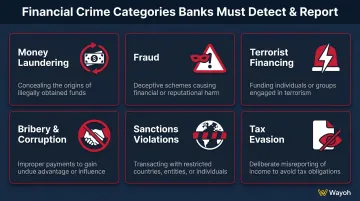
The crime categories FCC programs address often overlap and require coordinated response:
- Money laundering — concealing the origins of illegally obtained funds
- Fraud — deceptive schemes targeting the bank or its customers
- Terrorist financing — providing funds to support terrorist activity
- Bribery and corruption — misuse of financial access for improper gain
- Sanctions violations — transacting with prohibited individuals, entities, or jurisdictions
- Tax evasion — using financial institutions to hide taxable income
The UNODC estimates that between 2% and 5% of global GDP — roughly $800 billion to $2 trillion — is laundered annually. Banks sit at the center of that ecosystem.
Why Banking Faces the Highest Stakes
That central position comes with the broadest regulatory scrutiny of any industry. The Bank Secrecy Act, FinCEN regulations, OFAC sanctions requirements, and the Anti-Money Laundering Act of 2020 stack requirements on top of each other in a combination no other sector faces.
Penalties for failure don't follow a predictable curve. FinCEN's FY 2023 enforcement totaled $60.8 million across four actions. FY 2024 reached $3.4 billion across just two — a 55x increase in a single year. That kind of volatility means FCC program quality directly determines institutional survival, not just regulatory standing.
Core Components of an FCC Program
Anti-Money Laundering (AML)
AML is the backbone of most FCC programs. Driven by the Bank Secrecy Act in the U.S., AML compliance requires banks to monitor transactions, identify suspicious patterns, and file reports with FinCEN.
Key AML obligations include:
- Suspicious Activity Reports (SARs) — filed when a bank identifies a known or suspected federal criminal violation involving $5,000 or more; banks have 30 days to file after becoming aware
- Currency Transaction Reports (CTRs) — required for cash transactions exceeding $10,000 in a single day
- Ongoing transaction monitoring against behavioral baselines to flag anomalies before they escalate
With 4.7 million SARs filed in FY 2024, the filing infrastructure alone demands substantial human capital.
Know Your Customer (KYC)
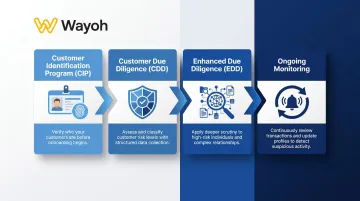
Where AML governs what banks report, KYC governs who they allow in. It's the first line of defense against onboarding bad actors. FinCEN's CDD Final Rule (31 CFR 1010.230), effective since May 2018, codifies four requirements for covered institutions:
| KYC Pillar | Requirement |
|---|---|
| Customer Identification (CIP) | Identify and verify customer identity |
| Customer Due Diligence (CDD) | Develop customer risk profiles |
| Enhanced Due Diligence (EDD) | Deeper investigation for high-risk relationships |
| Ongoing Monitoring | Detect suspicious transactions; update customer information on a risk basis |
Sanctions Screening
OFAC, UN sanctions lists, and EU designations require real-time screening of customers and transactions against prohibited parties. Penalties routinely exceed the value of the blocked transaction itself. OFAC enforcement totals swung from $48.8 million in 2024 to $1.54 billion in 2023 — largely driven by cryptocurrency cases — which means a single screening gap can cost more than an entire year of compliance operations.
Fraud Detection and Regulatory Reporting
Fraud detection overlaps significantly with AML but is often managed separately in larger institutions. Those operational silos are expensive — duplicated tooling, fragmented alerts, and investigations that span two teams rather than one. Many banks are now closing this gap through integrated FCC frameworks that consolidate financial crime functions under a single program.
Regulatory reporting ties it all together. SARs, examination readiness, and internal audit trails are the documentary record that determines whether a bank passes or fails scrutiny. The FFIEC BSA/AML Examination Manual sets the floor for what examiners expect to see across each of these areas.
Key Roles in a Financial Crime Compliance Team
BSA/AML Compliance Officer
This is the program lead. Per FFIEC requirements, the bank's board of directors must designate a qualified BSA compliance officer with genuine authority, independence from business lines, and adequate resources. The role carries personal legal liability — FinCEN and the OCC can pursue enforcement actions against individuals, not just institutions.
The scope scales with institution size, but the regulatory floor stays constant:
- Authority to be consulted on new products, services, and geographic expansion
- Direct reporting access to the board and senior management
- Demonstrated knowledge of BSA and the institution's money laundering and terrorist financing (ML/TF) risk profile
CAMS certification is widely expected at this level.
FinCrime Analyst
The operational core of any FCC team. FinCrime Analysts review transaction monitoring alerts, investigate suspicious customer behavior, write SAR narratives, and escalate high-risk cases.
The judgment calls involved — whether a pattern crosses the threshold for a SAR filing, which leads warrant deeper investigation — require both regulatory knowledge and investigative instinct. This is consistently one of the most in-demand roles in financial crime hiring.
KYC Analyst
Focused on customer onboarding due diligence and ongoing profile reviews. Standard CDD work is procedural; EDD assignments require genuine investigative depth:
- Adverse media searches
- Complex corporate structure analysis
- Source-of-wealth assessments
Many institutions treat these as separate role tiers rather than a single job description.
Sanctions Compliance Specialist
Responsible for screening customers and transactions against watchlists, resolving false positives, and maintaining real-time compliance with OFAC and other sanctioning bodies. This is a high-pressure, time-sensitive function with no margin for error. A missed match can trigger a regulatory examination. A flood of false positives can paralyze operations.
Compliance Manager / FCC Program Manager
The bridge between analysts and the CCO. This role handles workflow design, staff oversight, regulatory examination coordination, and policy updates. It's where experienced analysts advance — and where a weak hire creates measurable gaps across the entire compliance program.
Wayoh recruits for all of these roles across community banks, regional institutions, and fintech firms. In practice, compliance managers who can both lead teams and manage regulatory examinations firsthand are the hardest profiles to fill — they rarely respond to job boards, and most placements happen through direct outreach.
Essential Skills and Certifications for FCC Professionals
CAMS: The Baseline Standard
The Certified Anti-Money Laundering Specialist (CAMS), administered by ACAMS, is the most widely recognized credential in the FCC space. Over 65,000 professionals hold the certification globally across a community of 120,000+ ACAMS members.
| CAMS Detail | Information |
|---|---|
| Target experience | 18–24 months in anti-financial crime |
| Exam format | 120 questions, 3.5 hours |
| Curriculum areas | Risks & methods, global frameworks, program design, tools & technology |
| Recertification | Every 3 years |
ACAMS also offers specialized credentials worth noting: CGSS (sanctions), CKYCA (KYC), and CTMA (transaction monitoring) — useful for professionals deepening expertise in a specific function.
CFCS: Broader Financial Crime Coverage
The Certified Financial Crime Specialist (CFCS), administered by ACFCS, covers a wider scope than CAMS — fraud, corruption, and AML together. It's particularly valuable for roles that span both fraud and compliance functions, which are increasingly common as institutions move toward integrated FCC frameworks.
Technical and Soft Skills That Matter
Certifications establish baseline competency, but day-to-day effectiveness in FCC roles depends on a second layer of skills that don't always appear on a credential.
Technical skills banks prioritize:
- Experience with transaction monitoring platforms (Actimize, Mantas, FiServ)
- SAR narrative writing — clear, well-documented, legally defensible
- Open-source investigation (OSINT) capability
- Ability to interpret complex financial data patterns
Soft skills are harder to evaluate but equally important:
- Regulatory writing clarity under time pressure
- Ethical decision-making in gray-area situations — ambiguity is constant in this work
- Investigative curiosity — the instinct to ask the next question
- Risk communication to non-compliance stakeholders
The last category is the hardest to screen from a resume alone. It requires structured behavioral interviews and scenario-based assessments focused on regulatory exposure, communication style, and how candidates handle operational pressure.
The FCC Talent Gap: Building Stronger Compliance Teams
The Structural Shortage
The Bureau of Labor Statistics projects 3% growth in compliance officer employment through 2034, adding roughly 12,300 positions. That pace doesn't match the regulatory demand created by the AML Act of 2020, FinCEN's expanding reporting requirements, and the growing complexity of sanctions regimes.
The finance and insurance sector median for compliance officers sits at $79,920 — only marginally above the national median of $78,420. Specialized AML roles requiring CAMS certification and platform expertise command significant salary premiums above that figure. The 65,000 CAMS-certified professionals globally represent a finite pool competing across banking, fintech, and cryptocurrency simultaneously.
Why Standard Hiring Fails
Most qualified FCC candidates aren't applying to job postings. They're employed, performing well, and not actively searching. Reaching them requires network access that job boards don't provide.
Common mistakes when hiring without specialist support:
- Generic job descriptions that fail to reflect actual regulatory requirements
- Seniority mismatches — listing a role as mid-level when the actual accountability is senior
- Certification requirements listed as "nice to have" when regulators effectively require them
- Searching only the active candidate market, which excludes most experienced professionals
How Banks Can Build Better FCC Teams
Each of those mistakes is avoidable. Addressing them directly shapes whether a compliance team can hold up under regulatory scrutiny:
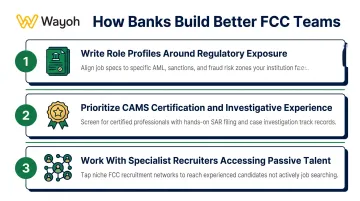
- Write role profiles around actual regulatory exposure — not a copy-paste from a previous posting. Vague descriptions attract unqualified applicants and signal to experienced candidates that the bank doesn't understand the function.
- Prioritize CAMS certification and demonstrated investigative experience over generic compliance backgrounds. A CAMS-certified analyst with SAR writing experience is not interchangeable with a general compliance coordinator.
- Work with recruiters who have direct access to passive talent and can assess regulatory fit beyond keyword matching.
Wayoh places FCC professionals across banking and fintech, including interim placements for audit preparation, remediation projects, and examination coverage when permanent searches take time. With over 500 placements in regulated industries, their sourcing model is built around professional networks rather than job boards — which is the only reliable way to reach experienced FCC talent that isn't actively looking.
Frequently Asked Questions
What does financial crime compliance mean?
Financial crime compliance (FCC) refers to the policies, procedures, and controls banks use to detect, prevent, and report illegal financial activity — including money laundering, fraud, terrorist financing, bribery, sanctions violations, and tax evasion. It's specifically focused on preventing criminal exploitation of financial systems.
What is AML compliance in banking?
AML compliance refers to the practices banks follow under the Bank Secrecy Act to detect and report money laundering. Core obligations include transaction monitoring, filing Suspicious Activity Reports (SARs) for suspected criminal activity involving $5,000 or more, and Currency Transaction Reports (CTRs) for cash transactions over $10,000.
What are 7 common types of financial crime?
Money laundering, fraud, terrorist financing, bribery and corruption, sanctions violations, tax evasion, and cybercrime. These crimes frequently intersect — a fraud scheme may involve money laundering, and cybercrime often enables sanctions evasion. Coordinated FCC programs exist precisely because no single crime type operates in isolation.
What are the 4 pillars of KYC?
Customer Identification Program (CIP), Customer Due Diligence (CDD), Enhanced Due Diligence (EDD), and Ongoing Monitoring. Together, these ensure banks verify who their customers are, assess their risk profiles, and detect suspicious behavioral changes over time.
What is the FinCEN rule?
FinCEN (the Financial Crimes Enforcement Network) administers rules under the Bank Secrecy Act covering SAR and CTR filing, AML program requirements, and beneficial ownership verification. It also publishes government-wide AML/CFT priorities that institutions must incorporate into their compliance programs.
What does a FinCrime analyst do?
A FinCrime analyst reviews transaction monitoring alerts, investigates suspicious customer activity, writes SAR narratives, and escalates high-risk cases to senior compliance staff. The role is highly sought-after at the entry-to-mid level, but consistently hard to fill because it demands both regulatory knowledge and genuine investigative instinct — a combination that's rarer than most hiring managers expect.