Introduction
Regulators are not issuing warnings — they're issuing bills. OFAC assessed $1.54 billion in penalties across 17 enforcement actions in 2023 alone, and TD Bank's October 2024 settlement reached a combined $3 billion across DOJ, OCC, and FinCEN — the largest BSA penalty in U.S. history. Most of these failures share a common thread: sanctions screening programs that lacked qualified human oversight at critical points.
That's a problem hiring managers feel directly. Demand for sanctions-specific compliance professionals has outpaced supply, and the certified talent pool hasn't kept pace. Institutions competing for the same narrow group of qualified candidates face extended hiring timelines, compensation pressure, and real compliance exposure while roles sit vacant.
This article covers what hiring managers in this space need to know:
- Key roles within a sanctions screening team
- Skills and credentials that separate qualified candidates from the field
- Why this hiring market is harder than general compliance recruiting
- How bank and fintech needs differ
- Practical steps to build a stronger team faster
TLDR
- AML sanctions screening is a distinct compliance function requiring specialized skills beyond general AML knowledge
- Core roles include Sanctions Screening Analysts, BSA/AML Compliance Officers, Sanctions Compliance Managers, and KYC/Sanctions Onboarding Specialists
- CAMS is the baseline credential; CGSS signals sanctions-specific depth — and hiring managers are increasingly requiring it
- Banks and fintechs face hiring challenges in this space, but they're looking for different candidate profiles
- A specialized recruiter like Wayoh cuts time-to-hire for these hard-to-fill roles — typically within weeks, not months
What Is AML Sanctions Screening — and Why It Requires Specialized Talent
Sanctions screening is the process of checking customers, counterparties, beneficial owners, and transactions against government and international watchlists — including OFAC's SDN List, the EU Consolidated Financial Sanctions List, the UN Security Council Consolidated List, and HM Treasury's financial sanctions targets — to prevent prohibited dealings and flag exposure to financial crime. In practice, executing that process accurately and defensibly is considerably harder than the definition implies.
Sanctions Screening vs. Transaction Monitoring
These two functions are frequently conflated, and candidates who treat them as interchangeable are a genuine red flag in interviews.
- Sanctions screening is preventive: it checks whether a party is designated before a transaction is processed or a relationship is onboarded
- Transaction monitoring is detective: it analyzes patterns in completed transactions to identify suspicious activity after the fact
The distinction matters in operations and in regulatory filings. Mixing them up in an exam or an escalation memo can expose an institution to real risk.
The Regulatory Framework Driving Demand
Skilled professionals are required — not optional — under multiple overlapping frameworks:
- FATF Recommendations 6 and 7 require countries and financial institutions to implement targeted financial sanctions (TFS) quickly and effectively, covering terrorism financing and proliferation financing respectively
- The Bank Secrecy Act establishes program, recordkeeping, and reporting requirements for U.S. financial institutions
- EBA/GL/2024/15, published November 2024, sets the first common EU-wide standards for sanctions governance and applies to banks, PSPs, and crypto-asset service providers — effective December 30, 2025
None of these frameworks are satisfied by software alone.
What Gets Screened — and Why It's Complex
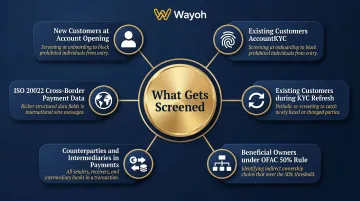
The scope of sanctions screening extends well beyond onboarding. Institutions must screen:
- New customers at account opening
- Existing customers during KYC refresh cycles
- Beneficial owners under OFAC's 50% Rule (entities owned 50% or more in aggregate by blocked persons are treated as blocked themselves)
- Counterparties and intermediaries in payment execution
- Payments against ISO 20022 structured data elements in cross-border transactions
Automated screening tools reduce false positives but cannot replace analysts who investigate ambiguous name matches and apply judgment under the OFAC 50% Rule. Documenting escalation rationale and closing alerts in a way that survives examiner scrutiny requires trained human judgment — and that's precisely where the quality of your hire determines the quality of your compliance program.
Key Roles in AML Sanctions Screening Teams
Banks and fintechs build sanctions screening teams across multiple levels — each role carries distinct responsibilities and requires different expertise. Here's how the core roles break down.
Sanctions Screening Analyst
The frontline role. Analysts review automated alerts, investigate potential watchlist matches, resolve false positives, and document findings in case management systems.
Strong candidates have:
- Hands-on experience with screening platforms (Accuity, Fircosoft, Oracle FCCM, or similar)
- Working knowledge of OFAC, EU, and UN sanctions lists
- Familiarity with fuzzy matching logic and how threshold settings affect alert volumes
- Ability to write defensible, examiner-ready disposition notes
BSA/AML Compliance Officer
A senior, formally designated role with direct regulatory accountability. Under 12 CFR 21.21(d)(3) (OCC) and equivalent FDIC, Fed, and NCUA requirements, banks must formally designate a qualified BSA compliance officer. Candidates must understand the full weight of that designation — not just in theory, but in terms of examination exposure and personal regulatory accountability.
Qualified candidates demonstrate:
- Genuine authority and independence from business lines
- Direct board access and reporting capability
- Practical experience with examiner-facing documentation and regulatory inquiries
Sanctions Compliance Manager or Program Manager
A mid-to-senior role that bridges analyst operations and executive-level policy. Responsibilities typically include:
- Designing and calibrating alert workflows
- Managing analyst team performance and escalation protocols
- Interfacing with compliance technology vendors
- Reporting to senior leadership on sanctions risk exposure
This role is particularly valuable for fintechs building out compliance infrastructure — it provides program-level oversight without requiring a full C-suite compliance hire.
KYC/Sanctions Onboarding Specialist
These specialists sit at the intersection of customer due diligence and sanctions screening — collecting and verifying customer data, screening against watchlists during onboarding, and flagging PEP (politically exposed person) concerns or adverse media hits. High demand in fintechs scaling customer acquisition, particularly in payments, crypto, and cross-border money movement.
Wayoh recruits for this profile across payments companies, lending platforms, digital banks, and crypto firms where onboarding volume creates sustained demand for these hybrid roles.
Essential Skills and Certifications for Sanctions Screening Professionals
Credentials That Matter
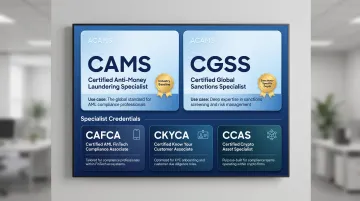
CAMS (Certified Anti-Money Laundering Specialist) from ACAMS is the industry baseline. Approximately 50% of AML and ATF job postings in North America require or prefer ACAMS certification — it signals foundational competency across financial crime compliance.
CGSS (Certified Global Sanctions Specialist), also offered by ACAMS, is the more targeted credential. It covers sanctions frameworks, evasion methodologies, compliance program design, and practical application of OFAC, EU, and UN regulations. Larger banks and global fintechs are increasingly requesting CGSS specifically for sanctions-focused roles, not just general AML positions.
For specialized roles, also consider:
- CAFCA — Certified AML FinTech Compliance Associate (fintech-specific)
- CKYCA — Certified Know Your Customer Associate (for onboarding-heavy roles)
- CCAS — Certified Cryptoasset Anti-Financial Crime Specialist (for crypto firms)
Technical Skills That Distinguish Strong Candidates
Certifications confirm baseline knowledge. What they don't reveal is how a candidate actually operates within a screening environment. Probe for these capabilities in interviews:
- Understands how phonetic and string-similarity algorithms work, and how threshold settings (OFAC's search tool uses a 50–100 scale) drive false positive volumes
- Familiar with ISO 20022 structured payment messaging — critical for cross-border screening accuracy, and a real learning curve for candidates who aren't
- Has hands-on experience with case management and screening platforms, not just conceptual awareness
- Can walk through OFAC 50% Rule ownership aggregation across multiple blocked persons without being prompted
Soft Skills Hiring Managers Underestimate
Regulatory knowledge shows up on a resume. Judgment under ambiguity does not. The most effective sanctions analysts share several behavioral traits:
- Comfort making defensible decisions on close-but-not-exact name matches without excessive escalation
- Clear, concise writing — disposition notes that a regulator can read and understand
- Consistency at high alert volumes without shortcuts
These qualities only surface through structured behavioral interviewing. Ask candidates to walk through a specific close-match scenario they've resolved — the reasoning they describe will tell you more than any competency question.
Why Hiring AML Sanctions Screening Talent Is So Challenging
The Supply-Demand Gap Is Growing
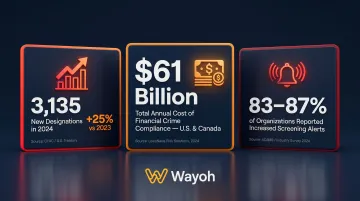
Treasury added 3,135 persons to the SDN List in 2024 — a 25% increase over 2023's 2,502 designations. Russia alone accounted for roughly 70% of new additions. Screening workloads are expanding faster than institutions can hire trained staff to manage them.
At the same time, LexisNexis reports the total annual cost of financial crime compliance in the U.S. and Canada reached $61 billion, with labor as the largest single cost component. 83–87% of organizations reported increased screening alerts over the past year. More alerts, same talent pool.
The Experience Trap
Most institutions require candidates with sanctions-specific experience — not just general AML background. That's reasonable. But it creates a bottleneck: the universe of professionals who have actually worked sanctions alert queues, applied the OFAC 50% Rule, and calibrated screening platforms is small. Many of the best candidates are passive — they're not browsing job boards.
Reaching them requires direct outreach and sustained market relationships, not reactive posting. That's why firms increasingly turn to specialized recruiters with existing networks in the sanctions compliance space rather than relying on inbound applications alone.
Compensation Pressure From Both Directions
Banks and fintechs are competing for the same candidates. Robert Half benchmarks general Compliance Officer salaries at $90,000–$132,000 nationally, with metro ranges running considerably higher. Sanctions specialists with CGSS credentials and platform experience typically command premiums above those benchmarks.
Neither side holds a clean advantage in the offer stage:
- Fintechs tend to win on equity, flexibility, and faster career mobility
- Banks tend to win on regulatory prestige, structured career paths, and stability
That split means compensation strategy needs to be defined before the search starts — not after a finalist walks.
Banks vs. Fintechs: Different Needs in Sanctions Compliance Hiring
The regulatory obligation to screen for sanctions exposure applies equally to banks and fintechs. The candidate who can actually meet that obligation looks very different depending on which environment they're walking into.
What Banks Need
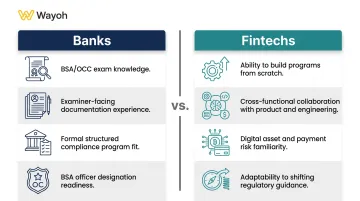
Community and commercial banks typically prioritize candidates who:
- Understand BSA regulatory requirements and OCC/FDIC examination expectations in depth
- Have direct experience with examiner-facing documentation and audit support
- Can operate within a formal, structured compliance program
- Meet the independence and authority requirements for formal BSA officer designation
Regulatory exam experience is especially valued — and hard to find in candidates coming from non-bank environments. Banks should test for documentation rigor, examiner communication, and knowledge of specific regulatory frameworks during interviews.
What Fintechs Need
Fintechs — particularly those in payments, crypto, or cross-border money movement — need a different profile:
- Ability to build compliance functions from early or foundational stages, not just operate within established frameworks
- Comfort working across product, engineering, and operations teams without a large compliance infrastructure in place
- Familiarity with the specific risk surface of digital assets, API-driven onboarding, or high-volume payment flows
- Adaptability as regulatory expectations shift — EBA GL/2024/15 and FATF's virtual asset guidance are two examples that have reshuffled fintech compliance priorities in recent years
OFAC enforcement shows fintechs face the same regulatory consequences as banks. Binance's $968 million OFAC settlement in 2023 wasn't treated differently because it involved crypto — the penalties matched what a bank would face for equivalent failures. Hiring someone who understands that reality, not just the technology, is the difference between a functioning program and a liability.
Tailoring the Interview Process
- For banks: Test regulatory knowledge, escalation documentation, and familiarity with examination processes
- For fintechs: Test problem-solving with non-compliance stakeholders, program design thinking, and comfort with ambiguity
Scenario questions work well in both contexts. A prompt like "Walk me through how you would handle an alert that is a close but not exact name match on the OFAC SDN list" quickly separates practitioners from candidates who have only studied the theory — and it surfaces how they communicate under pressure, not just what they know.
How to Build a Stronger AML Sanctions Screening Team
Start With a Precise Job Description
Vague job descriptions are one of the most common sources of wasted hiring time in compliance recruiting. A strong job description for a sanctions role should specify:
- The exact sanctions regimes the candidate will work with (OFAC, EU, UN, HM Treasury)
- The screening platforms currently in use
- Expected alert volumes and turnaround time requirements
- Escalation structure and reporting lines
- Whether the role requires formal BSA officer designation
Qualified candidates self-select in — and unqualified ones self-select out.
Use Scenario-Based Interviews
Competency-based questions tied to real decisions are the most reliable way to evaluate genuine sanctions experience. Examples:
- "How would you approach beneficial ownership screening for a corporate customer with complex holding structures?"
- "Describe how you would calibrate alert thresholds after a period of unusually high false positive rates."
- "Walk me through a time you escalated an alert that didn't clearly match but raised enough concern to warrant review."
None of these can be answered convincingly without hands-on experience — which is exactly the point.
Partner With a Recruiter Who Knows This Market
Sanctions screening is a narrow specialty. General job boards and internal HR teams rarely have the network depth to reach passive candidates with CGSS credentials and platform-specific experience.
Working with a specialist like Wayoh — with over a decade placing compliance, risk, and AML professionals across New York, California, and Florida — means access to pre-vetted sanctions screening candidates, including those who aren't actively job-hunting. For institutions under timeline pressure from an upcoming examination, a regulatory remediation, or rapid growth, that network reach compresses time-to-hire without sacrificing candidate quality.

Frequently Asked Questions
What is sanction screening in AML?
AML sanctions screening is the process of checking customers, transactions, and counterparties against official government and international watchlists — including OFAC's SDN List, the EU Consolidated List, and the UN Security Council List — to prevent financial institutions from engaging in prohibited dealings. It is a preventive control that operates before transactions are processed or relationships are established.
What are the 4 types of sanctions?
The four main types are: comprehensive sanctions (broad bans on an entire country), targeted sanctions (restrictions on specific designated individuals or entities), sectoral sanctions (restrictions on specific economic sectors such as energy or defense), and secondary sanctions (penalties applied to non-U.S. parties that transact with sanctioned persons or jurisdictions).
What certifications should AML sanctions screening candidates have?
CAMS (Certified Anti-Money Laundering Specialist) is the standard baseline credential for AML compliance professionals. CGSS (Certified Global Sanctions Specialist) is the more targeted certification for sanctions-specific roles — both are offered by ACAMS and are widely recognized by banks and fintechs during hiring.
How long does it typically take to hire a sanctions compliance professional?
Hiring timelines can range from 6 to 16 weeks depending on seniority and role specificity. Sanctions roles take longer than general compliance hires because the qualified candidate pool is significantly smaller. Working with a specialist recruiter who maintains direct relationships with passive candidates can cut that timeline considerably.
What is the difference between a BSA officer and a sanctions screening analyst?
A BSA officer owns the institution's entire BSA/AML compliance program at a senior level, interfaces with regulators, and is formally designated under regulatory requirements. A sanctions screening analyst is an operational role focused on reviewing and resolving watchlist alerts day-to-day — the BSA officer sets policy and program direction; the analyst executes it.
Do fintechs need the same AML compliance staff as banks?
Both must meet AML and sanctions compliance obligations, but the required profiles differ. Fintechs often need professionals who can build programs from scratch and work cross-functionally with product and tech teams. Banks typically prioritize candidates with regulatory examination experience and formal documented compliance frameworks.