The stakes are real. Healthcare breach costs averaged $9.77 million in 2024 — the highest of any industry for the 14th consecutive year — while financial services ranked second at $6.08 million per incident. Meanwhile, the ISC2 2024 Cybersecurity Workforce Study puts the global talent gap at 4.8 million unfilled positions, with roughly 700,000 of those in the U.S. alone.
For hiring managers in regulated industries, this isn't background noise. It's the environment you're recruiting in.
TL;DR
- Regulated sectors face a deeper talent crisis than other industries — compliance knowledge plus technical skill is a rare combination
- Banking, fintech, and healthtech each require distinct cybersecurity role profiles tied to their specific regulatory obligations
- Skills-based evaluation outperforms credential-first screening; 34% of hiring managers still require CISSP for entry-level roles despite it requiring five years of experience
- Most senior cybersecurity candidates aren't actively job hunting — effective sourcing requires direct outreach, not job postings
- Competitive offers go beyond salary — remote flexibility, certification budgets, and defined career tracks are deciding factors
Why Regulated Industries Face a Unique Cybersecurity Talent Crisis
The Compliance Layer Shrinks the Candidate Pool
The global shortage affects every sector, but regulated industries carry an extra filter. Hiring a capable security analyst who doesn't understand HIPAA audit controls or PCI DSS scoping isn't just a skills gap — it's a compliance liability. That's why the qualified pool for these roles is far smaller than in unregulated environments.
Here's what candidates need to know by sector:
- Banking: GLBA, FFIEC cybersecurity guidance, BSA/AML technology requirements
- Fintech: PCI DSS, SOC 2, state-level data privacy laws
- Healthtech: HIPAA Security Rule, HITECH, HITRUST framework
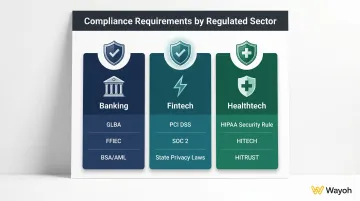
A generalist security hire without this background can pass a technical screen and still leave the organization exposed during an audit.
Burnout Is a Structural Problem, Not an Individual One
Security teams in banks and health systems operate under a dual mandate: proactive threat defense and reactive compliance audit support. That combination is exhausting in ways that general IT roles aren't. The data confirms it. The ISACA's 2025 State of Cybersecurity report found that **50% of organizations struggle to retain cybersecurity talent**, with 47% citing high stress as the primary driver of attrition. Separately, 66% of cybersecurity professionals say their role is more stressful now than five years ago, according to ISACA's 2024 survey.
Candidates with regulated-sector experience know exactly what they're walking into. Transparency about workload is a baseline expectation, not a differentiator — and organizations that gloss over it in the interview process tend to lose offers at the finish line.
Senior Candidates Are Not Applying to Your Job Posting
The most experienced cybersecurity professionals in banking, fintech, and healthtech are already employed, regularly contacted by competitors, and highly selective about where they move. A job board listing rarely reaches them — and even when it does, it rarely converts.
For regulated-sector employers, this means sourcing strategy matters as much as compensation. Effective approaches share a few common traits:
- Direct outreach through established professional relationships
- Referrals from within compliance and security networks
- Recruiters with prior exposure to the regulated-sector candidate pool
- Employer positioning that addresses compliance workload and growth trajectory upfront
The firms that consistently fill senior cybersecurity roles aren't waiting for inbound applications. They're building pipelines through trusted intermediaries with access to candidates who aren't actively looking.
Key Cybersecurity Roles Banks, Fintechs, and Healthtech Companies Are Hiring For
Role requirements vary significantly across these three sectors. Matching the position scope to the regulatory environment before writing the job description leads to faster, more accurate searches.
Roles in Banking
Banking cybersecurity skews toward compliance-integrated roles. The most common hires include:
- Cybersecurity Analyst — threat monitoring, SOC operations, alert triage
- Information Security Manager — policy ownership, internal audit support, team oversight
- GRC Analyst — governance, risk, and compliance program management across FFIEC and GLBA requirements
- Fraud & Financial Crimes Technology Specialist — technical fraud detection, transaction monitoring system management
These roles require candidates who can operate comfortably alongside compliance, legal, and risk teams — not just in a technical silo.
Roles in Fintech
Fintech security hiring focuses on engineering and cloud-native profiles, particularly for companies processing payments or managing customer financial data under PCI DSS:
- Application Security Engineer — securing APIs, payment flows, and software development lifecycles
- Cloud Security Architect — AWS/GCP/Azure security design for SaaS platforms
- Penetration Tester — external and internal testing of payment infrastructure and applications
- Security Operations Engineer — detection engineering, SIEM management, incident response tooling
Roles in Healthtech
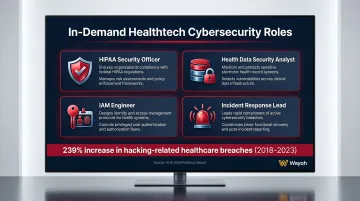
Healthtech hiring is shaped by HIPAA Security Rule requirements and a threat landscape that has grown sharply more hostile. HHS Office for Civil Rights reported a 239% increase in hacking-related healthcare breaches and a 278% increase in ransomware between 2018 and 2023. Demand for the following roles has risen in direct response:
- HIPAA Security Officer — compliance program ownership, risk assessments, workforce training
- Health Data Security Analyst — ePHI protection, access controls, data handling compliance
- IAM Engineer — identity and access management for clinical and administrative systems
- Incident Response Lead — PHI breach response, HHS notification management, forensic coordination
What to Look for When Evaluating Cybersecurity Candidates in Regulated Sectors
Skip the Credential-First Screen
The ISC2 2025 Cybersecurity Hiring Trends study found that 34% of hiring managers require CISSP for entry-level positions and 33% require it for junior-level roles — despite CISSP requiring a minimum of five years of professional experience. Requiring advanced certifications for roles that don't warrant them eliminates qualified candidates before a single conversation happens.
The better approach: use certifications as context, not gates. Someone with hands-on PCI DSS implementation experience and no certification is often more useful than someone who passed a certification exam without the field exposure.
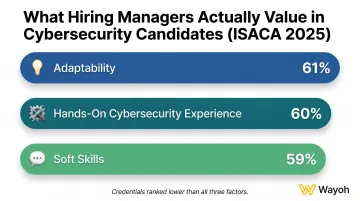
According to ISACA's 2025 research, the top qualification factors hiring managers actually value are adaptability (61%), hands-on cybersecurity experience (60%), and soft skills (59%) — communication, critical thinking, and problem-solving. Credentials ranked lower than all three.
Evaluate Technical Skills by Sector Context
Rather than running a generic technical screen, align your evaluation criteria to the regulatory environment:
| Sector | Technical Priorities |
|---|---|
| Banking | Network security fundamentals, SIEM experience, GRC platform familiarity |
| Fintech | Cloud security depth, API security, secure SDLC knowledge |
| Healthtech | HIPAA-specific controls, ePHI handling, healthcare incident response |
Test Regulatory Knowledge Through Scenarios
The difference between a candidate who can recite compliance rules and one who has implemented controls shows up immediately in scenario-based interviews. Use scenario questions to surface that distinction:
- "Walk me through how you'd build a PCI DSS-compliant logging architecture."
- "How would you respond to a potential HIPAA breach involving a third-party vendor?"
- "Describe how you've supported an FFIEC cybersecurity assessment at your current organization."
Strong candidates answer in specifics. Candidates with surface-level knowledge default to frameworks and generalities.
Communication Skills Are a Core Job Function
In regulated sectors, security professionals present risk to executives, defend controls to auditors, and coordinate with legal and compliance teams during incidents. Candidates who can translate a technical finding into a business risk — clearly, without jargon — will outperform more technically proficient peers who can't. Screen for it the same way you screen for technical depth.
How to Write Cybersecurity Job Descriptions That Work for Regulated Industries
Most cybersecurity JDs in regulated industries fail for one of two reasons: they over-specify credentials, or they use generic IT language that doesn't reflect the actual environment.
Getting both right starts with two straightforward fixes: show your regulatory environment, and write to the actual role.
What Signals Sector Credibility
- Name the specific frameworks your program operates under ("Our security program is built around HIPAA, HITECH, and SOC 2 Type II compliance")
- Describe the real scope and impact of the role, not just a task list
- Include a transparent salary range — passive candidates decide whether to engage based on this
- State remote or hybrid flexibility upfront; don't make candidates ask
What Turns Qualified Candidates Away
- Requiring CISSP or CISA for analyst-level roles — replace credential requirements with capability statements
- Listing responsibilities that span two or three separate roles in one description — common in under-resourced fintech and healthtech security teams, and it signals disorganization to experienced candidates
- Generic language like "responsible for ensuring security best practices" that could apply to any company in any industry
A passive candidate reading your JD is making a judgment call about your security program before they ever speak to anyone. The description that reads like it was written by someone who actually runs a mature security function will outperform one assembled from a template — every time.
Where and How to Source Cybersecurity Talent in Regulated Industries
Passive Candidates Require Proactive Outreach
Approximately 73% of professionals are passive candidates, according to LinkedIn data — meaning they're not browsing job boards or responding to postings. In regulated-sector cybersecurity, where specialized experience and job security are strong, that percentage skews even higher for senior roles.
Effective sourcing channels include:
- Financial services information security conferences and FS-ISAC community events
- CISO forums and executive security peer groups
- Fintech-specific security communities on LinkedIn and Slack
- Healthtech security networks and HIPAA compliance professional groups
Wayoh's recruiting model is built specifically for this dynamic. Rather than posting and waiting, the team engages known professionals through direct, relationship-led outreach — the approach that consistently surfaces candidates who wouldn't respond to a listing. With over 500 placements across banking, fintech, and healthtech in major U.S. markets including New York, California, and Florida, those relationships reach the candidates most organizations never see.
Internal Mobility Deserves a Harder Look
External sourcing isn't the only lever. IT professionals already working inside banks, health systems, and fintech companies often carry the compliance context that external hires spend months acquiring — including the regulatory environment, internal stakeholders, and systems architecture.
ISACA's 2025 report found that only 29% of enterprises are currently training non-security staff for cybersecurity roles — down from 41% the prior year — despite 46% of current security professionals having originally transitioned from non-security roles. Most organizations are underinvesting in the talent pipeline sitting right in front of them.
For hiring managers dealing with long external search timelines, pairing an internal mobility program with targeted external recruiting compresses time-to-hire without sacrificing the compliance depth these roles demand.
Building a Competitive Offer in a Compliance-Driven Market
Know the Market on Salary
Regulated industries pay at or above market median, and the data reflects it. According to the Robert Half 2026 Salary Guide, midpoint starting salaries run:
- Cybersecurity Analyst: $100,000–$132,000
- Systems Security Administrator: $110,000–$157,000
- CISO: $195,000–$267,000
Financial services CISOs specifically average $838,000 in total cash compensation according to Heidrick & Struggles' 2025 survey — the highest of any sector. The compliance burden placed on security staff in these industries is reflected in what they're paid.
Non-Salary Elements That Move Candidates
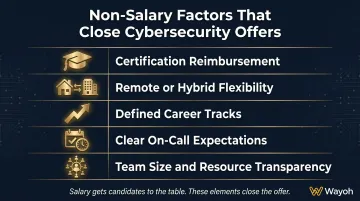
Salary gets candidates to the table. These elements close the offer:
- Certification reimbursement for CISSP, CISA, CCSP, or HIPAA-relevant credentials
- Remote or hybrid flexibility — a hard requirement for many senior candidates post-pandemic
- Defined career tracks that don't force technical specialists into management to advance
- Clear on-call expectations and incident response rotation schedules, disclosed upfront
- Team size and resource transparency — experienced candidates will ask, so answer before they do
Be Honest Early
Late-stage drop-off in a three-to-six-month search is costly — and most of it is preventable. Candidates with regulated-sector backgrounds will ask pointed questions about audit workload, team headcount, and incident frequency. Answering those questions honestly, early, builds the trust that keeps strong candidates engaged through a long process. Better communication upfront is almost always cheaper than restarting a search.
Frequently Asked Questions
What recruitment frameworks should I use when hiring cybersecurity talent?
Align your hiring framework to your sector's compliance obligations. Use NIST CSF and FFIEC guidance for banking roles, PCI DSS scope for fintech, and the HIPAA Security Rule for healthtech. Across all three, skills-based hiring (practical assessments over credential screens) consistently produces better results than credential-only filtering.
Can I make $200,000 a year in cybersecurity?
Yes. Senior roles including Security Architects, Security Directors, and CISOs at large financial institutions and healthtech companies regularly reach or exceed $200,000 in total compensation. Financial services pays at the top of the market — the Heidrick & Struggles 2025 CISO survey puts average total cash for financial services CISOs at $838,000.
What industries are most targeted by cyberattacks?
Financial services and healthcare are consistently among the most targeted sectors. IBM's 2024 Cost of a Data Breach Report found healthcare averaged $9.77 million per breach and financial services $6.08 million, both well above the $4.88 million global average. The Verizon 2024 DBIR found 98% of healthcare-sector attacks are financially motivated.
What cybersecurity roles are most in demand in banking and fintech?
Regulatory pressure and digital expansion are driving demand for a consistent set of roles across both sectors:
- GRC Analysts
- Security Operations Analysts
- Cloud Security Engineers
- Application Security Engineers
What certifications should cybersecurity candidates have for banking or healthtech roles?
CISSP and CISA are broadly valued for senior and compliance-oriented positions. CCSP is relevant in cloud-heavy environments. HIPAA-specific credentials (CHPS or HCISPP) carry particular weight in healthtech. Treat certifications as context rather than hard filters, especially for junior and mid-level roles.
How long does it take to hire a cybersecurity professional in a regulated industry?
Typically three to six months or more for senior roles, given thin candidate supply, background check requirements, and the need for sector-specific compliance knowledge. Firms that work with specialized recruiters who maintain active candidate networks in regulated industries tend to close searches faster than those relying on inbound applications alone.