Contract-to-hire staffing offers a structured path through that tension. Rather than forcing a permanent commitment before you've seen someone perform in your actual regulatory environment, it builds in an evaluation period — giving both sides time to assess fit before the offer is made.
This article covers what contract-to-hire is, why it fits regulated industries particularly well, which roles it works best for, how the process works in practice, and what to look for in a staffing partner.
Key Takeaways
- Contract-to-hire lets employers evaluate specialized talent in real working conditions before making a permanent offer
- Reduces hiring risk in compliance, risk, and legal roles where a bad fit carries real financial and regulatory consequences
- Supports rapid scaling during regulatory shifts without committing to permanent headcount
- Sector-specialized recruiters are essential — generalists rarely have the network or regulatory context these roles demand
What Is Contract-to-Hire Staffing?
Contract-to-hire (also called temp-to-hire or temp-to-perm) places a candidate with a company for a defined trial period — typically three to six months — during which both the employer and the professional evaluate fit. If both sides agree it's working, a permanent offer follows. During the contract period, the candidate is typically on the staffing agency's payroll, not the employer's.
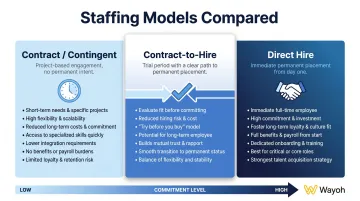
How It Compares to Related Models
| Model | Structure | Permanent Intent |
|---|---|---|
| Contract/Contingent | Project-based engagement | None — ends when project ends |
| Contract-to-Hire | Trial period with conversion path | Yes — structured pathway to permanent |
| Direct Hire | Straight to employer's payroll | Immediate — no trial period |
Contract-to-hire sits between the two extremes — more structured than a contingent engagement, with less upfront commitment than a direct hire.
A Mainstream Model, Not a Fallback
Contract-to-hire is not a second-tier option — the market data reflects a deliberate, growing preference for the model. According to the American Staffing Association, nearly 2.2 million temporary and contract employees work for staffing companies during an average week in the U.S., with the staffing industry generating $184 billion in revenue in 2024. Contract job postings have grown every year since 2022 — up 24% from 2022 to 2023, then 10% in 2024 and 7% in 2025 — while full-time postings declined over the same period.
Candidates are just as intentional about the model: 64% of staffing employees report choosing contract roles specifically to bridge into permanent employment. For most, the trial period isn't a consolation — it's the plan.
Why Regulated Industries Are Turning to Contract-to-Hire
In banking, fintech, and healthtech, a wrong hire doesn't just slow down a team — it can trigger audit failures, regulatory citations, or enforcement actions. That's the core reason regulated organizations have moved toward contract-to-hire faster than most sectors.
The Cost of Getting It Wrong
A failed hire in a compliance or risk function isn't just inconvenient — it's expensive. The U.S. Department of Labor estimates bad hires cost at least 30% of first-year earnings, while Gallup's research puts replacement costs at 0.5x to 2x annual salary. At the BLS median for compliance officers ($78,000–$90,000), a single failed hire can cost $23,000 to over $150,000 once you factor in recruitment, onboarding, and productivity loss.
The financial exposure is only part of it. A mishire in a BSA/AML function or a HIPAA privacy role can contribute directly to audit failures, regulatory citations, or enforcement actions.
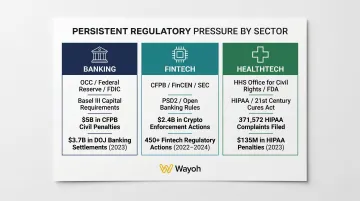
Persistent Regulatory Pressure Creates Staffing Spikes
Each of the three sectors faces recurring compliance cycles that drive sudden demand for specialized talent:
- Banking: Ongoing OCC and CFPB guidance changes; the CFPB alone has collected approximately $5 billion in civil money penalties and generated $19.7 billion in consumer relief through enforcement actions
- Fintech: State-by-state money transmitter licensing; FinCEN's proposed rule extending BSA requirements to stablecoin issuers would create an entirely new category of covered entities needing AML programs
- Healthtech: The FTC finalized amendments to the Health Breach Notification Rule in April 2024, expanding requirements for digital health apps; HHS OCR has received 371,572 HIPAA complaints since 2003
None of these are one-time events. Contract-to-hire lets organizations staff up for a regulatory milestone without locking in permanent headcount until they know the demand is sustained.
A Structural Talent Shortage
Qualified compliance professionals are scarce. The BLS projects 33,300 annual compliance officer openings over the next decade, driven primarily by replacement needs. Financial examiners are growing at 19% annually — far faster than average. Developing deep financial crime expertise typically requires 15 to 20 years of experience, a pipeline constraint that no salary increase can quickly resolve.
Contract-to-hire helps on both sides of that shortage: employers access pre-vetted professionals who might not commit to a permanent role without evaluating the organization first. For candidates in short supply, that evaluation period is often a prerequisite — making the model a genuine two-way test.
Roles Best Suited for Contract-to-Hire in Banking, Fintech & Healthtech
In regulated industries, the roles that gain most from contract-to-hire are those where judgment, regulatory fluency, and cultural alignment can only be assessed through actual work — not through an interview.
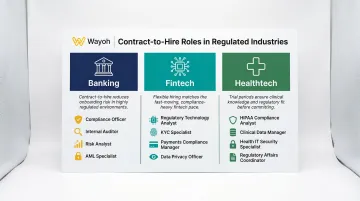
Banking
Community banks, commercial banks, and investment banks all use contract-to-hire for functions where regulatory risk demands scrutiny before a permanent commitment:
- BSA/AML analysts and compliance officers — regulatory knowledge and real-world judgment must be tested in context
- Loan review specialists — credit assessment quality is visible only through live work product
- Risk and credit analysts — methodology alignment and risk appetite fit take time to evaluate
- Internal audit professionals — independence, scope judgment, and reporting quality emerge through engagement
Fintech
Fintech companies face episodic compliance demand tied to licensing cycles, product launches, and new regulatory frameworks. That makes contract-to-hire a natural fit:
- Regulatory compliance specialists — particularly in lending, payments, and cryptocurrency
- Privacy and data governance analysts — especially as health apps and digital financial products face expanding notification requirements
- Legal and compliance counsel — supporting state licensing applications, product launches, or enforcement response
A fintech building out a crypto AML program or pursuing a money transmitter license needs specialized expertise immediately. Whether that role becomes permanent often depends on what the work reveals — and contract-to-hire preserves that decision until there's enough evidence to make it confidently.
Healthtech
As healthtech companies enter new markets or expand product lines, they need compliance professionals with specific domain knowledge. The contract period surfaces whether a candidate's experience actually maps to the company's product architecture and regulatory exposure:
- HIPAA compliance officers — privacy program design and enforcement readiness are job-specific
- Healthcare data analysts — data governance practices need to align with the company's product architecture
- Regulatory affairs specialists — particularly for companies navigating FDA, CMS, or state health regulations
- Privacy counsel — supporting HIPAA assessments, breach response, and data governance frameworks
With 65% of healthcare organizations reporting a shortage of qualified cybersecurity and compliance personnel (HIMSS, 2025), healthtech firms often can't afford to wait for a traditional hiring cycle to complete — or risk a permanent hire who doesn't fit the product.
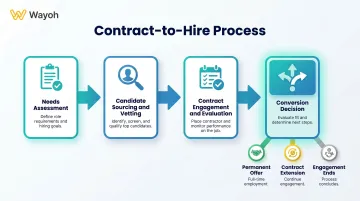
How the Contract-to-Hire Process Works in Regulated Industries
Step 1 — Needs Assessment
Before sourcing begins, a specialized staffing partner works with the hiring manager to define the role scope, regulatory knowledge requirements, contract duration, and conversion criteria. In regulated industries, this scoping phase must capture specific technical requirements — CAMS certification, FINRA licensing, HIPAA training credentials — that a generalist recruiter may not think to ask about.
Wayoh's intake process focuses on clarifying position scope, reporting structure, regulatory expectations, and the level of specialization required before any search begins. That upfront alignment reduces the chances of a mismatch on seniority level, credential gaps, or regulatory scope — issues that surface late and cost more to fix.
Step 2 — Candidate Sourcing and Vetting
Sourcing in regulated industries requires more than a job board search. Qualified compliance professionals — particularly those with CAMS certification or senior BSA/AML experience — often aren't actively applying. They're reachable through direct outreach and established professional networks.
Wayoh's sourcing is network-first: direct outreach, long-term market relationships developed over 10+ years, and consultative screening rather than keyword matching. Pre-placement vetting for every contract and interim role includes:
- Background checks and reference verification
- Direct assessment of technical and regulatory experience
- Credential confirmation (CAMS, FINRA licensing, HIPAA training where applicable)
Step 3 — Contract Engagement and Evaluation
During the contract period, the candidate works embedded in the team — handling real responsibilities, not shadow assignments. Both sides should use this time to evaluate what an interview cannot reveal: how the professional applies regulatory judgment under pressure, how they communicate with internal stakeholders, and whether their risk philosophy aligns with the organization's.
Wayoh conducts weekly check-ins with placed consultants throughout the engagement. This ongoing communication catches friction early — before it affects performance or team continuity — and reduces the management burden on client hiring teams.
Step 4 — Conversion Decision
At the end of the contract term — typically three to six months — three outcomes are possible:
- Permanent offer — both sides are aligned and the candidate joins the company's payroll
- Contract extension — more evaluation time is needed, or the business need is ongoing
- Engagement ends — the fit isn't right, or the role's scope has changed
Whichever direction a placement moves, commercial terms shouldn't be a last-minute conversation. Wayoh establishes conversion fees transparently from day one, so clients can plan their hiring budgets accurately before committing to a placement. There are no surprise terms at the conversion stage.
What to Look for in a Staffing Partner for Regulated Industries
Sector-Specific Expertise
A generalist recruiter who doesn't understand the difference between BSA and AML, or can't evaluate a HIPAA privacy officer's program experience, cannot effectively vet candidates for these roles. That knowledge gap shows up directly in candidate quality and, eventually, in costly mis-hires.
The right partner brings genuine domain fluency. That means knowing:
- What a CAMS certification requires and how to assess it
- Why FINRA Series 7 sponsorship matters for certain roles
- What separates a well-run BSA program from a superficial one
Wayoh's recruiters work exclusively in regulated industries — banking, fintech, and healthtech — with over a decade of experience and 500+ placements across compliance, risk, and legal functions.
Transparency and Process Structure
Hiring managers in regulated industries need visibility into how candidates are being sourced, screened, and evaluated. A structured, transparent process protects both the employer and the candidate, and reduces the likelihood of a placement mismatch that costs both sides time.
Key indicators of a strong process:
- Clear sourcing methodology (network-first vs. job board dependent)
- Defined vetting steps — background checks, reference calls, regulatory knowledge assessment
- Regular engagement updates throughout the search
- Conversion fee structure disclosed before the engagement starts
Geographic and Market Reach
New York alone accounts for approximately 848,900 employees in financial activities, making it the largest U.S. hub for financial services hiring. San Francisco, Chicago, Charlotte, and Boston carry the next largest concentrations of banking and fintech compliance professionals — and sourcing well means having active networks in those specific markets.
A staffing partner with active networks in these markets will produce stronger candidate pipelines than one drawing from a broad national job-board search. Wayoh's active coverage spans New York, California (San Francisco and San Diego), Florida, Texas, and Chicago — the key corridors for banking, fintech, and healthtech compliance hiring.
Frequently Asked Questions
How does contract-to-hire staffing work?
A candidate is placed with a company for a defined trial period — typically three to six months — during which they're evaluated for permanent hire. During this period, they're usually on the staffing agency's payroll. If both sides agree the fit is right, a permanent offer follows.
What is the difference between contract staffing and contract-to-hire staffing?
Contract staffing is project-based with no expectation of permanent employment — the engagement ends when the work is done. Contract-to-hire is specifically structured as a pathway to a full-time role, with the intent that the company will extend a permanent offer if the engagement goes well.
Do contract-to-hire positions usually lead to a full-time job offer?
Conversion is common but not guaranteed — it depends on performance, budget, and role fit. In specialized fields like compliance and risk, where qualified candidates are scarce, employers convert successful placements at higher rates than general staffing, simply because restarting the search is costly and time-consuming.
What is the average fee for contract-to-hire staffing?
Fees typically involve a markup on the candidate's hourly rate during the contract period, plus a conversion fee at permanent hire — which some agencies reduce or waive if the candidate completes the full contract term. Always request a clear, written fee structure before the engagement begins.
Do contract-to-hire employees get benefits?
During the contract period, benefits depend on the staffing agency — some provide health insurance and other coverage. Employer-provided benefits — such as company health plans and paid time off — typically don't begin until the candidate converts to a permanent employee of the hiring company.
Is contract-to-hire staffing legitimate?
Yes — it's a well-established, widely used employment model across regulated and professional industries. Legitimate agencies never charge job seekers fees to apply or be placed, and they're upfront about pay rate, contract duration, and conversion criteria from the start.