Industry estimates from SHRM put replacement costs at 50–200% of annual salary. For enterprise AEs specifically, factor in a 9–12 month ramp period and the pipeline damage from an empty or underperforming seat, and a single mis-hire can easily exceed $100,000 in direct costs alone—before accounting for lost deals.
The core problem: top enterprise AEs aren't browsing job boards. Most are passive candidates who need to be reached through relationships and sector-specific networks. Generic tech recruiters, without GTM depth, routinely miss the profile nuances that separate a strong enterprise AE from a mid-market rep with a polished pitch.
This guide covers what makes enterprise AE recruiting different, a curated list of specialist firms, and how to evaluate the right recruiting partner for your growth stage.
TL;DR
- Enterprise AEs require a recruiting approach built around deal complexity, quota history, and ICP fit — not résumé keyword matching
- Specialist GTM recruiting firms tap passive networks and vet against enterprise sales criteria, cutting time-to-hire and mis-hire risk
- Top firms for this search: Betts Recruiting, HireDNA, Captivate Talent, Optimal Sales Search, and Talentfoot
- Evaluate partners on: passive network depth, ICP and deal-size vetting capability, and compensation benchmarking
- Contingency fees typically run 20–30% of first-year salary; retained search runs 25–35% of total first-year compensation, paid in installments
Why Enterprise AE Hiring Requires a Specialist Recruiter
The Profile Is Genuinely Hard to Find
An enterprise AE isn't a scaled-up version of a mid-market rep. The role requires managing multi-threaded buying committees, navigating 9–18 month sales cycles, and consistently closing deals with ACV above $100,000. That combination of skills, patience, and deal complexity experience is rare—and candidates who have it are almost never actively looking.
According to data cited by LinkedIn's talent blog, passive candidates make up a significant share of the total talent pool, and among top performers that figure climbs further. For enterprise AEs specifically, the most qualified people are typically already exceeding quota somewhere. That makes outbound, relationship-driven sourcing the only realistic path to finding them—and the first place generalist recruiters tend to fall short.
Why Generalist Recruiters Underperform Here
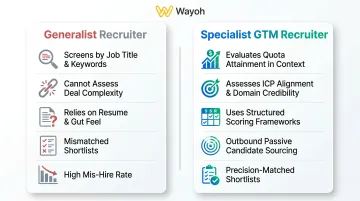
Most generalist tech recruiters screen by job title and keyword. They can't reliably distinguish between:
- An AE who closed five $250K+ deals last year vs. one who hit quota on 40 smaller transactions
- Candidates with genuine multi-stakeholder experience vs. those who managed a single economic buyer
- Someone with ICP-relevant domain knowledge vs. a strong communicator with no vertical credibility
The result is mismatched shortlists, extended searches, and a high probability of the wrong hire. HireDNA reports that approximately 67% of B2B sales hires underperform or leave within 18 months, linking the failure rate to over-reliance on resumes and gut feel instead of structured evaluation.
Specialist GTM recruiting firms take a different approach: they evaluate deal complexity, quota attainment in context, ICP alignment, and domain credibility—the factors that consistently separate high performers from candidates who interview well. The firms listed below have built their entire practices around exactly this kind of hire.
Top Recruiters Specializing in Enterprise AE Hiring for High-Growth Tech Companies
These firms were selected based on demonstrated focus on enterprise and strategic AE placements within tech and SaaS, candidate network depth, and client track record at growth-stage companies.
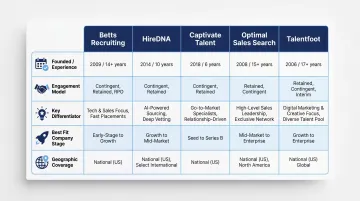
Betts Recruiting
Founded in 2009 in San Francisco, Betts Recruiting works exclusively with tech companies to place GTM talent—including mid-market, enterprise, and strategic AEs. Their proprietary platform, Betts Connect, gives hiring teams direct access to tens of thousands of pre-vetted candidates. Key capabilities include:
- Filters by quota attainment, average deal size, and industries sold to
- Native integrations with Greenhouse and Lever
- FitScore ranking that compressed one client's search from 20 hours to one hour per hire
Zendesk used Betts Connect to hire over 50 AEs and SDRs (self-reported by Betts).
| Category | Details |
|---|---|
| Engagement Model | Contingent search, Recruitment-as-a-Service (RaaS) subscription, platform-only via Betts Connect |
| Enterprise AE Specialization | Mid-market to strategic AEs at SaaS companies; FitScore filters for quota attainment and deal size |
| Key Markets | New York, San Francisco, Los Angeles, Austin, Chicago, Denver, Miami, Seattle, Toronto; remote supported |
HireDNA
HireDNA takes an AI-powered approach to enterprise AE recruiting, scoring candidates across 46 data points covering role fit, sales experience, culture alignment, and selling style. Their FitScore integrates Objective Management Group (OMG) assessment scores, giving hiring managers a comparative ranking system rather than a stack of resumes to sort through.
Their G2 High Performer recognition across five consecutive periods reflects consistent client satisfaction. For enterprise AE searches—where a bad hire typically costs 6–9 months of salary—structured scoring replaces subjective screening with measurable criteria.
| Category | Details |
|---|---|
| Engagement Model | Contingent and retained search; includes interview scorecards and real-time hiring analytics |
| Enterprise AE Specialization | FitScore methodology designed to surface AEs with enterprise deal experience, compensation alignment, and cultural fit |
| Key Markets | U.S.-focused with nationwide placement capability; remote enterprise AE hiring supported |
Captivate Talent
Founded in 2017, Captivate Talent recruits exclusively for early- to growth-stage SaaS startups—Series A through C companies that need enterprise AEs who can work without a defined playbook, build a territory, and sell an emerging product into large accounts.
Their 94% retention rate at 12 months and 95% client return rate are the standout numbers here. Captivate also advises on competitive compensation packages and brand positioning to help close passive candidates who have no shortage of options.
| Category | Details |
|---|---|
| Engagement Model | Contingent search with dedicated search support and compensation advisory included at no extra cost |
| Enterprise AE Specialization | Evaluates enterprise AE candidates on adaptability to early-stage environments alongside deal complexity and quota track record |
| Key Markets | U.S.-focused; remote-first and distributed SaaS companies |
Optimal Sales Search
Optimal Sales Search has been placing GTM talent since 2004, with Bay Area roots and a national reach. Their explicit focus on "hunter" AEs—reps who consistently prospect and close new enterprise logos rather than managing existing accounts—makes them well-suited for high-growth companies that need net-new revenue.
With 500+ placements and a claimed 52% reduction in search time, their two decades of market intelligence shapes how they frame opportunities to passive candidates—particularly senior AEs who aren't browsing job boards but will take a call from a trusted contact.
| Category | Details |
|---|---|
| Engagement Model | Permanent/direct hire only; founder-led search with structured intake and three-to-five-year trajectory planning |
| Enterprise AE Specialization | Hunter AE profiles with enterprise new-logo experience; deep SaaS domain knowledge across multiple verticals |
| Key Markets | Bay Area, nationwide U.S.; strong networks in West Coast and major enterprise tech hubs |
Talentfoot
Chicago-based Talentfoot brings a consultative model to enterprise AE recruiting. Before sourcing begins, their team maps your ICP and sales environment, then pre-vets candidates down to the top three to five. They use certified Hogan psychometric assessments to evaluate candidates on leadership potential and behavioral fit—not just quota history.
Their 98% success rate and 2,500+ clients served reflect 15 years of SaaS executive search. The Hogan assessment is most useful for companies hiring enterprise AEs into player-coach or future leadership tracks, where how someone sells matters as much as what they've closed.
| Category | Details |
|---|---|
| Engagement Model | Retained and contingent search; multi-stage vetting including Hogan assessments; consultative intake and search design |
| Enterprise AE Specialization | Sales motion alignment, ICP history, and leadership potential assessments for enterprise AE candidates |
| Key Markets | U.S.-nationwide; SaaS, IT, and industrial tech sectors; in-person and remote placements |
How to Choose the Right Enterprise AE Recruiting Partner
What the Best Firms Have in Common
The firms profiled above share a few structural traits worth understanding when evaluating any recruiting partner:
- Assessment methodology over sourcing volume: HireDNA's 46-point FitScore, Talentfoot's Hogan assessments, and Optimal Sales Search's hunter screening all reflect the same insight — the search isn't the hard part, the evaluation is
- Passive candidate access: None of these firms rely primarily on active job seekers. Their value comes from outbound reach into networks where the best enterprise AEs already sit
- GTM fluency: Recruiters who can't discuss MEDDPICC, deal complexity, or what separates an enterprise motion from mid-market cannot adequately assess candidates for those roles
Common Mistakes to Avoid
- Choosing a generalist firm with no GTM depth: Generalist tech recruiters screen by title, not by deal size, sales cycle complexity, or ICP alignment
- Prioritizing speed over fit: A fast shortlist of wrong candidates costs more than a slightly longer search for the right one
- Skipping placement proof: Ask for specific examples of enterprise AE placements — OTE range, deal size, quota context, and company stage
Evaluation Criteria That Matter
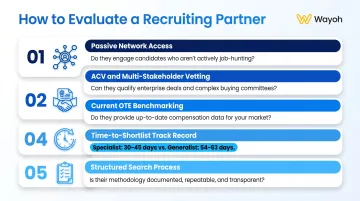
Ask any recruiting partner these questions before engaging:
- Can they reach enterprise AEs who aren't on job boards?
- How do they evaluate ACV history and multi-stakeholder experience?
- Do they have current OTE data by geography, segment, and stage?
- What's their time-to-shortlist track record? Specialist GTM recruiters typically deliver qualified shortlists in 30–45 days; generalist timelines average 54–63 days or more
- Do they provide structured updates and a clear search process throughout the search?
For fintech and healthtech companies, there's one more requirement that most generalist firms can't meet: sector credibility. Enterprise AEs selling into regulated industries need to understand the buyer's environment — compliance obligations, procurement processes, and the risk tolerance of large financial or healthcare institutions.
Wayoh has spent over a decade placing professionals across banking, fintech, and healthtech, which means their recruiters already speak that language. Their relationship-led sourcing model and compensation benchmarking capability make them a practical partner when AE candidates need both sales excellence and regulatory market fluency. Contact info@wayoh.co to discuss your search.
Conclusion
Enterprise AE hiring is too consequential to hand off to a generalist recruiter. With ramp times reaching 9–12 months and replacement costs potentially exceeding $100,000, a mis-hire in this seat doesn't just hurt the quarter—it resets the clock on a year-long investment.
The right specialist recruiting partner brings capabilities a generalist can't match:
- Access to passive candidates who aren't on job boards
- A vetting framework built around deal complexity and ICP fit, not keyword matching
- Market intelligence that helps you compete for talent at every stage of the process
Evaluate recruiting partners on sector depth, demonstrated enterprise AE placement history, and how well they align candidate profiles to your specific sales motion and growth stage—not on brand name alone.
For fintech and healthtech companies where domain credibility matters as much as sales performance, Wayoh brings over a decade of regulated industry hiring and 500+ placements to enterprise AE searches. Reach out at info@wayoh.co to discuss your hiring needs.
Frequently Asked Questions
Is it worth finding a job through a recruiter for enterprise AE roles at high-growth tech companies?
Specialist recruiters give enterprise AE candidates access to roles that are rarely posted publicly and can advocate on compensation based on current market benchmarks. They match your deal history and ICP experience to the right-stage company, for a faster, more targeted search than going it alone.
What is the average cost of a headhunter for enterprise AE hiring?
Contingency search fees typically run 20–30% of first-year salary, paid only upon successful placement. Retained search for senior enterprise AEs runs 25–35% of total first-year compensation, paid in installments at engagement, shortlist, and hire—clarify upfront whether fees are calculated on base salary or full OTE.
How long does it typically take to fill an enterprise AE role through a recruiting firm?
Specialist GTM recruiters can often deliver a qualified shortlist in 30–45 days, with an offer extended within 4–8 weeks. Generalist agencies typically run longer—the 2025 cross-industry average is 63.5 days, and enterprise roles with narrow candidate pools often exceed it.
What makes enterprise AE recruiting different from hiring other sales roles?
Hiring for enterprise AEs demands a documented track record in high-ACV, multi-stakeholder, long-cycle deals—attributes that require specific sourcing and vetting methods. Most generalist recruiters cannot reliably evaluate deal complexity, quota attainment in context, or ICP alignment, which leads to mismatched shortlists.
Should I use a retained or contingency recruiter for enterprise AE hiring?
Contingency works for faster fills with lower upfront financial risk. Retained search is better for hard-to-fill or senior enterprise AE roles where you need dedicated effort, deeper candidate vetting, and a recruiter who's exclusively focused on your search rather than working multiple concurrent mandates.
How do I evaluate whether a recruiting firm truly specializes in enterprise AE hiring?
Ask for proof of recent enterprise AE placements—specifically deal size, OTE range, and company stage. Request their candidate vetting process for quota attainment and ICP alignment. Confirm they have passive networks in enterprise sales, not just access to candidates who applied to a job posting.