Introduction
Most engineering teams don't underperform because of a talent shortage. They underperform because the hiring strategy is wrong and the culture isn't strong enough to keep good people once they arrive.
The market conditions make this harder to ignore. The U.S. Bureau of Labor Statistics projects software developer employment to grow 15% from 2024 to 2034, adding roughly 153,900 openings annually — while tech unemployment sits near 2.3%. Demand is outpacing supply, and in regulated industries like fintech, healthtech, and banking, the challenge is sharper. You need engineers who understand compliance constraints — not just ship features.
That's the gap this guide addresses. It's a practical playbook for CTOs, engineering leaders, and talent decision-makers building teams in regulated environments. By the end, you'll know how to:
- Define what elite engineering performance actually looks like
- Build a culture that attracts and holds strong engineers
- Source and vet candidates effectively for high-compliance roles
- Retain top performers long-term
- Recognize when a specialized recruiting partner is the right call
TL;DR
- Elite engineering teams run on ownership, iteration speed, and measurable outcomes — credentials are just one input.
- Culture drives both attraction and retention more than compensation; it doesn't happen by accident.
- Most senior engineers are passive candidates; job postings alone won't reach them.
- A rushed bad hire costs more than leaving a role open. Structured vetting is worth the time.
- In fintech and healthtech, domain-aware hiring is a competitive advantage most teams underuse.
What Makes an Engineering Team "Elite"?
Elite engineering teams are defined by how they operate, not just who they hire.
The highest-performing teams share a recognizable operational profile:
- Take ownership of outcomes, not just assigned tasks
- Move through iteration cycles quickly and proactively
- Debug and solve problems before being asked
- Collaborate across product, design, and operations without friction
They ship with velocity — and they care about what they're shipping.
High-Performing Teams vs. High-Performing Individuals
A group of technically strong individuals is not automatically a high-performing team. Elite teams have shared context, mutual trust, and systems that reduce coordination friction. When those things are absent, "star player" teams stall — decisions get bottlenecked, ownership is ambiguous, and velocity drops.
Google's Project Aristotle research, which studied roughly 180 teams over two years, found that psychological safety — not individual talent — was the top predictor of team effectiveness. The other factors were dependability, structure, meaning, and impact. Notably, who was on the team mattered less than how the team functioned together.
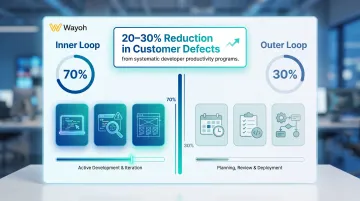
McKinsey's research on developer productivity reinforces this: top-performing firms target around 70% of developer time in the "inner loop" (actual building and problem-solving), and systematic productivity programs have produced 20–30% reductions in customer-reported defects. That's a team-systems outcome, not an individual one.
The Regulated-Industry Dimension
For organizations in banking, fintech, and healthtech, "elite" carries an additional requirement. Engineers need domain literacy — an understanding of compliance constraints, data security protocols, and audit-readiness as part of their default workflow. The best engineers in these environments don't treat regulatory requirements as obstacles handed down from legal. They architect around them from the start.
This distinction matters for hiring. A technically exceptional engineer without that domain fluency can introduce more risk than a slightly less technical engineer who understands what a compliance exception actually means.
Building the Right Engineering Culture from Day One
Strong engineering cultures attract talent organically. Top engineers want to work on meaningful problems alongside other strong engineers — and they can tell within weeks whether a company's environment supports that or undermines it.
Google's early investment in 20% time — allowing engineers to pursue self-directed projects — wasn't just a perk. It was a deliberate signal that the company trusted its engineers to think, not just execute. That signal attracted and retained engineering talent at scale.
What an Engineer-Led Culture Looks Like
In practice, an engineer-led culture means engineers have real input on product direction, technical architecture, and tooling choices. They're not just receiving specifications — they're shaping how problems get solved.
Leaders who treat engineers as pure executors create attrition traps. When engineers have no agency over the technical environment they work in, the best ones leave. They have options.
A few markers of a healthy engineering culture:
- Engineers can raise architecture concerns without political risk
- Technical debt is acknowledged and scheduled for remediation, not buried
- Blameless postmortems are standard after incidents
- Career growth paths include deep technical tracks, not just management ladders
- Tooling and infrastructure decisions involve the engineers who use them daily
Mission Clarity and Retention
Engineers are drawn to problems that matter. A compelling technical mission — not just a job description — is a genuine recruiting and retention asset.
Glassdoor's research found that a single-star increase in employee satisfaction corresponds to a 6% drop in the likelihood of applying elsewhere. In technical services, that effect was even stronger — roughly 8.5% per star. Culture satisfaction doesn't just affect morale; it directly affects whether your engineers are actively searching for their next role.
Sustaining Culture as the Team Scales
Culture erodes without deliberate maintenance. What worked at 12 engineers breaks down at 60 if you don't actively tend to it.
Practices that help:
- Regular engineering all-hands focused on technical direction, not just company updates
- Internal tech talks and demo days that make craft visible
- Open code review culture where feedback is normalized, not feared
- Transparent investment in individual career development
- Protecting technical decision-making authority from being gradually overridden by non-engineering functions as the company grows
That last point is more common than it should be. As companies scale, product and business stakeholders often accumulate influence over technical choices. When engineers lose agency over their own stack, retention problems follow quickly. When engineers lose agency over their own stack, retention problems follow quickly — which is why culture isn't a soft concern. It's a structural one that directly shapes who stays, who leaves, and who you're able to hire next.
How to Source Top Engineering Talent
Job postings capture active candidates. Active candidates are a minority.
According to the Stack Overflow 2024 Developer Survey, only 18% of developers are actively looking for a new role. Another 64% are open to opportunities but not applying anywhere. That means the best senior engineers — the ones already doing excellent work somewhere — are almost never browsing job boards. You have to reach them directly.
The Multi-Channel Sourcing Approach
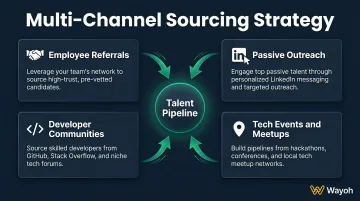
No single channel reaches all the talent worth hiring. A functional sourcing strategy covers:
- Employee referrals: Consistently among the highest-quality sources of hire, producing candidates who arrive with context and social proof. Operationalize this with an incentive structure that actually motivates participation.
- Targeted passive outreach: LinkedIn, direct email, and community engagement aimed at engineers not currently looking. Personalization matters here; generic InMails get ignored.
- Developer communities: GitHub, open-source contributors, Stack Overflow, and domain-specific Slacks or Discord servers. Engineers active in these spaces often have both technical depth and genuine intellectual engagement.
- Tech events and meetups: Industry-specific conferences, local engineering meetups, and fintech or healthtech-focused forums where domain-literate engineers self-select into the room.
Fintech and Healthtech-Specific Sourcing
General sourcing channels frequently surface technically strong candidates who lack compliance awareness. That's a problem in regulated environments where an engineer's judgment about data handling or system architecture has legal and operational consequences.
Industry-specific networks and specialized recruiting partners with deep domain connections are worth the investment. Wayoh, for example, has spent over a decade building relationships with engineers across fintech, healthtech, and banking. That means their pipeline includes candidates who already understand what it means to build in a regulated environment — not just technically capable people who need to get up to speed.
Employer Brand as a Sourcing Asset
What engineers say about your company online either accelerates or kills your pipeline. Glassdoor reviews, LinkedIn comments, Twitter/X posts, and word-of-mouth in engineering communities all influence whether strong candidates respond to your outreach.
Building inbound interest before a recruiter ever makes contact requires consistent visibility. Tactics that move the needle include:
- Publishing engineering blog posts and technical thought leadership
- Contributing to open-source projects
- Participating visibly in developer communities and tech events
This is a long-term investment, but it compounds.
Vetting Engineers: Quality Over Speed
Speed-first hiring is a false economy. A fast bad hire introduces technical debt, team drag, and rework costs that consistently outrun the cost of leaving a role open longer.
U.S. Department of Labor guidance puts a bad hire at roughly 30% of first-year salary. SHRM has documented cases where total costs exceeded $240,000–$250,000 when recruiting, onboarding, and lost productivity are fully accounted for. In regulated environments, add compliance exposure and the downstream cost of reversing decisions an underqualified hire made in production.
What Strong Vetting Actually Looks Like
Effective vetting goes well beyond resume screening. A rigorous process for engineering roles includes:
- Real system design discussions that expose how a candidate thinks through tradeoffs — not trivia questions
- Debugging exercises grounded in realistic scenarios, not contrived whiteboard problems
- Tradeoff analysis prompts where there's no clean answer, revealing judgment under pressure
- Behavioral interviews that surface how they've navigated ambiguity, production incidents, and team conflict
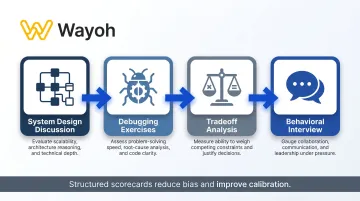
Without structure, this kind of process defaults to gut-feel — which tends to favor confident communicators over strong builders and introduces systematic bias. Structured scorecards and consistent evaluation rubrics fix both problems. They create a shared language across the hiring team and force calibration before anyone makes a decision.
Role-Specific Calibration
A backend infrastructure engineer, a data engineer, and a frontend engineer should not run through identical interview screens. Role-specific criteria improve signal quality and reduce false positives — this is especially important in regulated environments where judgment and ownership matter as much as technical output.
Define the must-have competencies for each role before the first interview. Then evaluate against those criteria consistently, using anchored ratings rather than impressionistic summaries.
Retaining Elite Engineers Once You've Hired Them
Retention is a day-one responsibility — the habits and systems you build during onboarding set the tone for everything that follows.
A structured first-month integration plan should include:
- A real problem to solve (not just documentation reviews)
- Architectural context for the codebase they're entering
- Clear ownership expectations from the start
- Feedback on judgment and communication — not just code quality
"Sink or swim" onboarding is common and wasteful. It takes a strong hire and turns them into a disengaged one within months.
Why Engineers Leave
The Stack Overflow 2024 survey found that 37% of job-seeking developers cite better compensation as a top motivator, and technical debt is the top frustration for 63% of professional developers. Those two data points together tell you a lot: engineers leave when they feel underpaid and when they feel their time is being wasted on work that doesn't matter.
The core retention levers:
- Meaningful technical challenges — engineers who are bored leave. Keep them working on problems that stretch them.
- Clear growth paths — technical leadership tracks matter as much as management tracks. Not every strong engineer wants to manage people.
- Transparent compensation — compensation misalignment is often invisible until it's too late. Publish bands, review regularly, and benchmark against market.
- Strong management — engineers consistently cite poor management as a top reason for leaving. Invest in engineering manager development.
The Compounding Value of Retention
Retained engineers accumulate institutional knowledge, architectural ownership, and mentorship capacity that makes the entire team more productive over time.
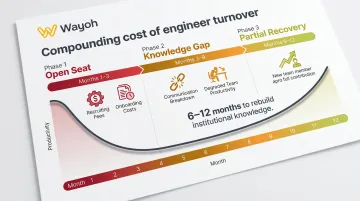
Every engineer who leaves takes context with them that takes 6–12 months for a replacement to rebuild. In regulated environments with complex compliance architectures — fintech, healthtech, banking — that knowledge gap is even more expensive. Turnover compounds: the cost isn't just the open seat, it's the degraded productivity of everyone left behind.
When to Partner with a Specialized Tech Recruiter
Internal hiring breaks down in predictable scenarios:
- Hard-to-fill niche roles where your team lacks the network to source passively
- High-volume scaling needs that overwhelm internal capacity
- Confidential senior searches where discretion is essential
- Domain-specific roles — like fintech compliance engineering — where evaluating candidates requires knowledge your internal team may not have
What Separates a Strong Recruiting Partner from a Resume Broker
A genuine partner understands the technical role, assesses candidates beyond keyword matching, communicates transparently, and supports the transition post-placement. A high-volume contingency model optimizes for submission speed: you get more resumes faster, but quality suffers and mis-hires follow.
Wayoh's model operates differently. Rather than database-driven matching, the firm uses a network-first search approach built on relationships developed over more than 10 years in regulated-industry hiring. Candidates are sourced through direct conversations, not keyword filters, which surfaces passive candidates with the right domain experience rather than just whoever happens to be actively applying.
For engineering roles, Wayoh's evaluation goes beyond resume screening. Each candidate is assessed across:
- Technical background and domain depth
- Sector fit and regulatory environment familiarity
- Communication skills and alignment with hiring goals
For interim placements, that includes full references and background checks before presentation. Wayoh also supports offer management and onboarding coordination, reducing the friction that causes strong candidates to fall out at the final stage.
With over 500 placements across banking, fintech, and healthtech — covering full-stack engineers, infrastructure specialists, security, and product engineering roles — Wayoh is worth evaluating when your internal team hits its limits. Service coverage spans major U.S. markets including New York, California, and Florida.
Frequently Asked Questions
How do you build an effective engineering team?
Start with culture — an engineer-led environment with psychological safety, meaningful technical challenges, and clear ownership expectations. Then layer in rigorous multi-channel sourcing and structured vetting. Culture shapes who wants to join. Vetting confirms whether they can actually perform.
Where can I find engineers to hire?
The most productive channels are employee referrals, targeted passive outreach on LinkedIn, developer communities like GitHub and open-source projects, and niche tech events. For regulated industries, specialized recruiting firms with deep domain networks surface candidates that general channels miss — particularly passive ones.
What makes an engineering team high-performing vs. just technically skilled?
High-performing teams share context, move fast, own outcomes, and communicate well under pressure. Individual technical skill is necessary but not sufficient — engineers without those team habits can still collectively underperform, especially when coordination costs are high or ownership is unclear.
How do you retain top engineers after hiring them?
The core levers are meaningful technical challenges, clear growth paths (including non-management tracks), transparent compensation, and strong onboarding from day one. For most professional developers, technical debt is the top frustration. Addressing it proactively is one of the most direct retention investments available.
What's the difference between a tech recruiting agency and an in-house talent team?
In-house teams offer deep company context and direct process control. External agencies bring broader market reach, passive candidate access, and specialized domain knowledge — especially for regulated industries or niche roles. Most mature organizations use both.