The result: healthtech companies are no longer asking whether they need dedicated compliance and cybersecurity staff. They're asking how fast they can hire them.
OCR's proposed HIPAA Security Rule overhaul, new congressional legislation like HISAA and the Health Care Cybersecurity and Resiliency Act, and the FDA's active enforcement on medical device cybersecurity are converging on compliance teams that, in many cases, were designed for a simpler regulatory era. Add AI and IoT expansion to the picture, and the talent gap becomes acute.
This article outlines five hiring trends shaping healthtech cybersecurity compliance in 2026 — and what organizations need to understand to stay ahead of the curve.
TL;DR
- OCR's proposed HIPAA Security Rule updates are eliminating the "required vs. addressable" distinction, expanding compliance headcount requirements across covered entities
- Change Healthcare and Ascension breaches are driving boards to create standalone CISO roles, separate from general IT leadership
- AI diagnostics and connected medical devices are generating demand for cross-disciplinary roles that blend cybersecurity and regulatory expertise
- HITRUST and NIST CSF certifications — incentivized by HITECH safe harbor provisions — are now a baseline hiring requirement, not a bonus credential
- Legal and compliance functions are converging, creating demand for hybrid Privacy & Compliance Counsel profiles that were rare just three years ago
Trend 1: Proposed HIPAA Security Rule Updates Are Forcing Compliance Team Expansion
What's Changing
OCR's Notice of Proposed Rulemaking, issued December 27, 2024, proposes structural changes that would raise the compliance floor for every covered entity and business associate. The key proposals include:
- Eliminating the "required vs. addressable" distinction, making core specifications mandatory across the board
- Mandating MFA and encryption for all ePHI at rest and in transit
- Requiring documented technology asset inventories and network maps, updated annually
- Requiring vulnerability scanning every six months and annual penetration testing
- Expanding documentation requirements across policies, procedures, plans, and risk analyses
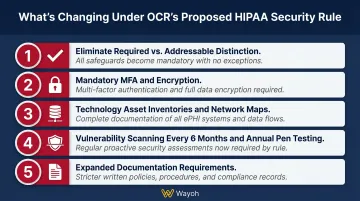
The HHS OCR NPRM fact sheet confirms that minimum obligations are expanding substantially, not being tweaked at the margins.
Why Enforcement Is Expected to Get Stricter
A November 2024 HHS OIG report found that OCR's prior audit program reviewed only 8 of 180 HIPAA requirements — with just two tied to Security Rule administrative safeguards and none covering physical or technical safeguards. Organizations correctly interpret this as a signal that deeper, more prescriptive audits are coming.
The Hiring Implication
That audit gap won't hold. Organizations that previously managed HIPAA compliance with a generalist or part-time resource are now under pressure to hire:
- Dedicated HIPAA Compliance Specialists to manage expanded documentation
- Risk Analysts to conduct required assessments and gap analyses
- Technical Safeguard Specialists familiar with MFA, encryption, and penetration testing requirements
Wayoh helps healthtech companies source compliance professionals with direct HIPAA expertise — including candidates already familiar with the proposed rule's expanded technical and documentation requirements.
Trend 2: Major Breach Activity and New Legislation Are Driving Healthcare CISO Demand
The Catalyst
The Change Healthcare ransomware attack and the Ascension breach — which affected roughly 5.6 million patients — weren't just operational disasters. They became board-level conversations about whether security leadership structures were adequate. At organizations without a dedicated CISO, the answer was often uncomfortable.
Legislative pressure is adding to that urgency. The Health Infrastructure Security and Accountability Act (HISAA) proposes minimum cybersecurity standards for HIPAA-covered entities, with Medicare-related programs to support organizations accelerating safe practices post-incident.
If similar provisions advance as Medicare Conditions of Participation, organizations without a dedicated security leader could face reimbursement consequences. That makes the CISO hire a financial imperative, not just a strategic one.
What This Looks Like in Hiring
Healthtech companies that previously relied on shared IT leadership or part-time security consultants are now creating standalone roles:
- Chief Information Security Officers with healthcare delivery and vendor risk experience
- VPs of Security who can build programs from the ground up, not just manage existing infrastructure
- Security Directors with experience navigating HIPAA-specific incident response requirements
The ISC2 2024 Workforce Study confirms the global cybersecurity workforce gap persists despite reaching approximately 5.5 million professionals — and healthcare-specific demand compounds that scarcity further.
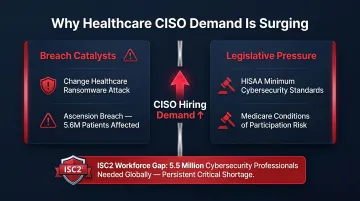
Organizations pursuing these hires need to define scope clearly and offer competitive compensation. Passive candidates with regulated-industry experience and healthcare delivery expertise are rarely looking at job boards.
Trend 3: AI and IoT Integration Is Creating New Cross-Disciplinary Cybersecurity Roles
The Expanding Attack Surface
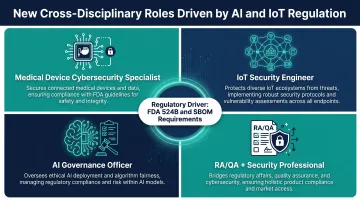
As AI-assisted diagnostics, remote patient monitoring, and connected medical devices become standard in healthtech infrastructure, the regulatory environment is catching up. FDA Section 524B — added by the Consolidated Appropriations Act of 2023 — now requires cyber device premarket submissions to include a Software Bill of Materials (SBOM) and a documented plan to monitor, identify, and address vulnerabilities on an ongoing basis.
The FDA's cybersecurity FAQ for medical devices makes clear that these aren't aspirational guidelines — eSTAR technical screening actively enforces submission completeness.
New Roles Emerging
This regulatory environment is generating demand for professionals who don't fit neatly into traditional security or compliance categories:
- Medical Device Cybersecurity Specialists who understand both SBOM governance and FDA Quality System Regulation requirements
- IoT Security Engineers with experience in clinical environments and connected device lifecycle management
- AI Governance Officers bridging responsible AI frameworks and regulatory obligations
- Cross-functional RA/QA + Security professionals who can navigate both regulatory affairs submissions and security architecture decisions without handoffs
That regulatory pressure is driving demand from both healthtech vendors building these products and provider organizations deploying them. The problem: most candidates have depth in one domain, not both, making cross-disciplinary hires genuinely scarce.
Trend 4: HITRUST and NIST Framework Adoption Is Making Certified Talent a Competitive Requirement
The Safe Harbor Incentive
Public Law 116-321 requires HHS to consider adoption of "recognized security practices" — including NIST CSF, HICP, and HITRUST mappings — when determining penalties and audit remedies. This isn't theoretical: the HHS 405(d) program operationalizes HICP specifically for the healthcare sector, and the 2024 Health-ISAC/KLAS benchmarking study documents measurable preparedness improvements among organizations using NIST CSF.
For compliance and legal teams, this translates directly: demonstrating recognized framework adoption can reduce enforcement exposure and improve cyber insurance terms.
How This Affects Hiring
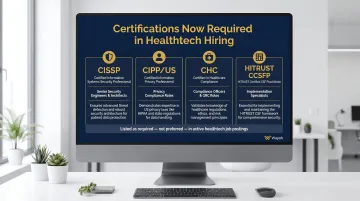
Healthtech companies pursuing HITRUST certification or NIST CSF alignment are now writing that experience into job requirements — not just preferred qualifications. Certifications now listed as required in healthtech job descriptions include:
- CISSP for senior security engineers and architects
- CIPP/US for privacy-focused compliance roles
- CHC (Certified in Healthcare Compliance) for compliance officer and GRC roles
- HITRUST CCSFP for implementation-focused specialists
HITRUST certification spans 19 control domains. Organizations pursuing it frequently discover they lack the internal expertise to implement required controls at pace. Specialized compliance staffing firms help bridge that gap — and firms like Wayoh, with over a decade of relationships in regulated hiring markets, can close these capability gaps faster than open-market searches typically allow.
Trend 5: Privacy Counsel and Compliance Roles Are Converging
Regulatory Complexity Is Blurring Traditional Boundaries
HIPAA was never the whole picture, but the gap between HIPAA and the full regulatory landscape is widening. Several overlapping statutes now apply to healthtech companies operating across multiple states:
- Washington's My Health My Data Act (RCW 19.373) — covers "consumer health data" beyond HIPAA scope; active enforcement began in 2024
- California's CMIA (Confidentiality of Medical Information Act) — adds obligations for companies with California operations
- A growing wave of state-level health privacy laws — multiple additional states have advanced health-specific statutes in the past two years
A compliance professional whose expertise stops at HIPAA is no longer equipped to support a healthtech company with multi-state operations.
The Hybrid Role in Demand
Organizations are increasingly seeking candidates who combine:
- JD credentials or substantive legal experience
- Operational compliance program management skills
- Working knowledge of HIPAA, HITECH, state health privacy statutes, and FDA cybersecurity requirements
Titles like Privacy & Compliance Counsel, Deputy Chief Privacy Officer, and Regulatory Affairs Manager (Privacy) — profiles that were rare three years ago — are now regularly posted at mid-size and growth-stage healthtech companies. Wayoh's work in this space reflects that shift — placing candidates who can move between legal counsel and compliance operations, rather than specialists confined to one lane.
What's Driving These Healthtech Cybersecurity Hiring Trends
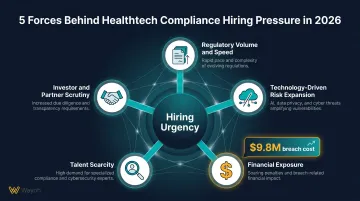
Five forces are converging at once — and that's exactly why healthtech hiring pressure looks different in 2026 than it did even two years ago:
Regulatory volume and speed — The OCR HIPAA Security Rule NPRM, HISAA, the Health Care Cybersecurity and Resiliency Act, and FDA's 524B requirements represent more new compliance obligations in 2024–2026 than any comparable prior period.
Technology-driven risk expansion — AI, cloud infrastructure, IoT medical devices, and interoperability mandates are collectively expanding the attack surface faster than existing compliance teams can keep pace.
Financial exposure — Healthcare's average data breach cost reached $9.8 million in 2024, the highest of any industry per IBM/Ponemon — making prevention-focused compliance hires a measurable business decision. HIPAA civil penalties carry annual caps of up to $1.5 million per violation category.
Talent scarcity — The global cybersecurity workforce gap persists even as it grows. Healthcare-specific demand for professionals with HIPAA, HITRUST, and clinical-environment experience outstrips supply — making early hiring matter more than it did three years ago.
Investor and partner scrutiny — Healthtech companies navigating venture due diligence, M&A processes, or enterprise healthcare partnerships are asked to demonstrate their compliance infrastructure. Having credentialed compliance and security staff in place is increasingly a prerequisite for closing those deals.
Together, these pressures explain why healthtech compliance hiring has shifted from a back-burner operational task to a front-of-house strategic priority — and why the right hire now can determine whether a company scales or stalls.
How These Trends Are Impacting Healthtech Organizations
Operational Impact
Compliance workflows are becoming substantially more resource-intensive. HIPAA documentation requirements under the proposed NPRM, HITRUST assessments spanning 19 control domains, and incident response planning that meets both OCR and potential legislative standards all require dedicated staff hours that generalists cannot absorb.
Healthtech organizations are responding by building dedicated GRC (Governance, Risk, and Compliance) functions. Compliance is no longer a secondary responsibility assigned to an IT manager — it's becoming its own organizational discipline with defined headcount, budget authority, and direct reporting lines to the C-suite.
Business Impact
Compliance investment is shifting from cost center to value driver. Organizations that can demonstrate:
- Certified compliance staff (CISSP, CIPP/US, CHC, HITRUST CCSFP)
- Active HITRUST or NIST CSF alignment
- Documented incident response capabilities
...are winning contracts with hospital systems and payer networks faster than competitors who can't. That competitive gap is widening as procurement and vendor risk teams at enterprise health systems add compliance criteria to their evaluation scorecards.
Workforce Impact
The structural shift is visible in org charts. Healthtech companies are creating layered compliance departments with distinct roles:
- HIPAA Compliance Specialists and Documentation Officers
- Security Engineers and Penetration Testing Leads
- Privacy Attorneys and Regulatory Affairs Managers
- GRC Analysts and Risk Managers
All reporting to a dedicated CISO or Chief Compliance Officer — rather than dotted-line relationships to IT or Legal. This consolidation is happening at companies that, two years ago, would have considered it premature.
Future Signals for Healthtech Cybersecurity Compliance Hiring
Several indicators will determine whether current hiring demand accelerates or plateaus:
- Final HIPAA Security Rule rulemaking — The NPRM's 60-day comment window has closed; final rule publication would trigger immediate implementation timelines and new hiring mandates
- Legislative passage of HISAA or the Health Care Cybersecurity and Resiliency Act — The HELP Committee advanced a version of the latter in 2026; enactment would formalize minimum standards
- Expanded FDA enforcement on 524B — As SBOM requirements mature, device manufacturers and deployers face growing pressure to hire dedicated SBOM and device security staff
- AI governance formalization — Organizations are elevating AI Compliance Officers and Responsible AI Leads from exploratory titles to essential hires as AI embeds itself in clinical and administrative workflows
Each of these signals points in the same direction: more mandatory standards, tighter enforcement windows, and a narrower pool of qualified candidates to meet them.
The scenario to plan for: if minimum cybersecurity standards become a Medicare Condition of Participation, mid-size and smaller healthtech organizations will face immediate pressure to build compliance teams that don't currently exist. The talent pool is already constrained — organizations that move now will have vetted candidates in place while competitors are still writing job descriptions.
Conclusion
The organizations navigating 2026's regulatory environment well aren't waiting for mandates to finalize before they hire. They're treating compliance talent as a strategic investment — and moving early. That means:
- Hiring certified professionals before regulations lock in
- Building GRC functions before audits arrive
- Creating CISO roles before a breach forces the decision
Understanding the regulatory landscape is only part of the equation. The companies that pull ahead are the ones that convert that understanding into an actual team — credentialed, specialized, and built to execute. Knowing what's coming and having the people to respond to it are two very different things.
Frequently Asked Questions
Frequently Asked Questions
What cybersecurity compliance roles are most in demand at healthtech companies in 2026?
HIPAA Compliance Officers, Healthcare CISOs, GRC Analysts, HITRUST Specialists, and Privacy Counsel are in high demand. Proposed HIPAA Security Rule updates and HISAA's minimum standards provisions are accelerating hiring across all these functions simultaneously.
What certifications should a healthtech cybersecurity compliance professional have?
CISSP, CIPP/US, CHC (Certified in Healthcare Compliance), and HITRUST CCSFP are the most in-demand credentials. Employers are increasingly listing these as required qualifications rather than preferred — particularly for senior compliance and security roles.
How are proposed HIPAA Security Rule updates changing what compliance teams look like?
Eliminating the "required vs. addressable" distinction and adding annual pen testing and expanded documentation requirements means organizations need dedicated staff for technical safeguard implementation and ongoing documentation management — functions previously absorbed by generalists.
Should healthtech startups hire a full-time CISO or use a fractional security leader?
Fractional CISOs offer cost efficiency for early-stage companies. Once a company is actively pursuing enterprise contracts or HITRUST certification, a full-time CISO becomes critical for audit credibility and sustained compliance oversight.
What is the typical timeline for hiring a qualified healthtech cybersecurity compliance professional?
Most healthtech companies find these searches take 60–120 days, given the overlap of HIPAA knowledge, technical skills, and certifications required. Working with a recruiter who maintains a pre-vetted network in this niche — like Wayoh — can cut that timeline in half.
How does HITRUST certification affect a healthtech company's hiring strategy?
HITRUST certification requires implementation expertise across 19 control domains — more than most internal teams can cover without dedicated hires. Companies pursuing certification frequently engage specialized compliance staffing firms to close capability gaps quickly and maintain momentum through the assessment process.