Standard ATS platforms built for software startups skip the credentialing rigour. Tools designed for clinical healthcare ignore the velocity side. Neither fits a digital health company hiring a compliance officer, a clinical informaticist, and a senior engineer in the same quarter.
The stakes are real. The BLS projects 15% employment growth for health information technologists through 2034 — well above the national average — and the EEOC received 88,531 new discrimination charges in FY2024, a 9%+ increase over the prior year. Healthtech hiring teams operating without structured, documented workflows are building liability into every open requisition.
This article covers five compliance-friendly recruitment tools, what makes each one relevant for healthtech, and how to evaluate them against your organization's actual regulatory obligations.
TL;DR
- Most generic ATS tools are built for speed or compliance — rarely both. Healthtech hiring demands the full picture.
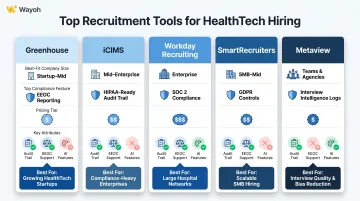
- Greenhouse, iCIMS, Workday Recruiting, SmartRecruiters, and Metaview each address a distinct stage of the hiring workflow with different compliance depth
- Evaluate tools on EEOC/OFCCP documentation, HIPAA-aware data handling, audit trails, and credential tracking
- Tools were selected based on compliance infrastructure, healthtech applicability, and support for both technical and regulatory roles
- These tools manage workflow. Placing the right compliance and regulatory professionals still requires human expertise.
Why Healthtech Hiring Demands Compliance-First Recruitment Tools
Healthtech companies aren't pure tech firms. They handle sensitive health data, partner with health systems, and employ roles — compliance officers, regulatory affairs specialists, clinical informaticists, privacy professionals — that require verified credentials and documented hiring decisions. When a generic software startup misfiles a rejection email, it's an inconvenience. When a healthtech company does the same during a Series B audit or EEOC inquiry, it's a legal exposure.
The Specific Compliance Risks
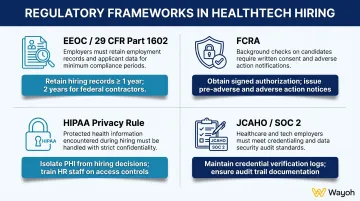
Four regulatory frameworks intersect at the healthtech hiring stage:
- EEOC (29 CFR Part 1602): Private employers with 15+ employees must retain all hiring records — applications, interview notes, test results, and documentation for unselected candidates — for at least one year. If a discrimination charge is filed, records must be kept until final disposition.
- FCRA: Before running a background check, employers need written candidate consent and a standalone disclosure. Before taking adverse action based on the report, they must provide a pre-adverse action notice with a copy of the report.
- HIPAA: Counterintuitively, HIPAA's Privacy Rule excludes employment records from protected health information — even when held by a covered entity. This shifts the compliance burden to EEOC, FCRA, and state law. Healthtech HR teams sometimes assume HIPAA governs candidate data handling when it doesn't.
- JCAHO / SOC 2: For healthtech companies partnering with health systems or pursuing SOC 2 certification, evidence that hiring processes were structured and auditable can surface during assessment reviews.
Where Generic Tools Fall Short
Standard tech-startup ATS platforms are optimized for speed: quick applications, informal feedback, Slack-based interview debriefs. That workflow doesn't generate the documented decision trail an EEOC audit or investor due diligence review expects. The problem isn't that decisions were made badly — it's that there's no record showing they were made consistently.
Compliance-ready recruitment tools address this by embedding structure directly into the workflow:
- Structured interview scorecards with consistent evaluation criteria
- Automated EEOC data collection at the application stage
- Documented rejection reasons tied to each candidate record
- Secure candidate data handling with role-based access controls
Top 5 Compliance-Friendly Recruitment Tools for Healthtech Hiring
These tools were selected for their compliance infrastructure, healthtech applicability, and ability to support both technical and compliance/regulatory roles — not just clinical staff.
Greenhouse
Greenhouse is a structured hiring platform widely adopted in the tech sector, built around configurable interview scorecards and documented hiring workflows. Its compliance architecture is transparent and tier-specific, which makes it easier to evaluate against actual regulatory obligations.
What makes it stand out for healthtech: Greenhouse enforces structured, bias-reduced interview processes that generate documented decision trails from application through offer. EEOC questionnaires are available across all tiers; resume anonymization and a comprehensive audit log unlock in the Pro tier.
For healthtech firms facing regulatory audits or investor due diligence, the Pro tier's audit log is the relevant feature. It captures every hiring action in a tamper-evident record.
Greenhouse integrates directly with Checkr for background screening and lists multiple other background check vendors in its partner directory. Its HRIS integrations are broad, reducing the risk of data silos between recruiting and onboarding.
| Feature | Details |
|---|---|
| Compliance Features | EEOC/OFCCP data collection (all tiers), structured interview scorecards, resume anonymization (Pro), comprehensive audit log (Pro) |
| Best For | Mid-size healthtech companies hiring technical and compliance roles who need repeatable, documented hiring workflows |
| Pricing | Three tiers (Core, Plus, Pro); custom pricing based on hiring volume — available upon request at greenhouse.com |
iCIMS
iCIMS is an enterprise-grade talent acquisition suite covering the full hiring lifecycle — from job distribution through onboarding — with compliance tooling built for regulated industries. It processes 200+ million applications annually across 3+ million platform users and markets directly to healthcare organizations.
iCIMS holds ISO 27001 and ISO 27701 certifications (2025), maintains secure audit trails that cannot be altered per its IT Security Policy, and uses FIPS 140-2/140-3 certified encryption. Its published case study with Novant Health documents how a major health system used the platform to digitally transform talent acquisition — a concrete demonstration of healthcare-sector depth.
For healthtech companies partnering with health systems or operating under complex multi-framework compliance obligations, iCIMS offers one of the most defensible security postures in this category.
| Feature | Details |
|---|---|
| Compliance Features | ISO 27001/27701 certified, immutable audit trails, FIPS-certified encryption, healthcare industry vertical with credential-tracking support |
| Best For | Larger healthtech companies or those partnering with health systems that need enterprise compliance infrastructure across multiple hiring workflows |
| Pricing | Enterprise pricing, available upon request; scales with organization size |
Workday Recruiting
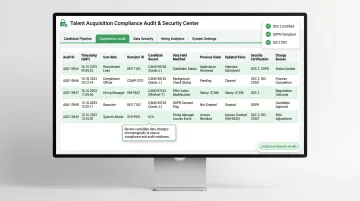
Workday Recruiting is the talent acquisition module within Workday's broader HCM and ERP platform. It was named a Leader in the 2024 Gartner Magic Quadrant for Cloud HCM Suites for enterprises with 1,000+ employees, and its 2024 acquisition of HiredScore added AI-powered bias mitigation protocols to the recruiting workflow.
What makes it stand out for healthtech: The unified HCM architecture is the core differentiator. A compliance officer's hire, onboarding records, credential documentation, and performance data all live in one auditable system — no data migration between platforms, no version conflicts during an audit. Workday's VIBE Index supports DEI tracking and workforce equity analysis, while HiredScore's Responsible AI and Bias Mitigation protocols create defensible screening records.
The trade-off is real: Workday Recruiting requires purchasing the core HCM platform, which raises both cost and implementation complexity. Early-stage companies will find it oversized; growth-stage and enterprise organizations already on Workday infrastructure are the natural fit.
| Feature | Details |
|---|---|
| Compliance Features | HiredScore bias mitigation, VIBE DEI framework, role-based data access controls, unified audit trail across HR/recruiting/payroll |
| Best For | Growth-stage or enterprise healthtech companies already on Workday HCM needing a single source of truth for talent data and compliance |
| Pricing | Among the higher-cost options; requires core HCM purchase — pricing available upon request |
SmartRecruiters
SmartRecruiters is a cloud-based talent acquisition platform known for its intuitive interface and multi-stakeholder hiring workflows. SAP completed its acquisition of SmartRecruiters in September 2025, integrating it into the SAP SuccessFactors HCM suite — adding enterprise backing and long-term platform stability.
Its ease of adoption across mixed hiring teams matters more than it sounds. When medical directors, HR business partners, and department heads all use the same tool correctly, decisions get documented. When a platform is too complex for clinical stakeholders, teams route around it — and that's where compliance gaps form.
SmartRecruiters' GDPR compliance architecture includes automated data deletion and consent management. The Essential tier starts at $14,995, making it the most price-transparent option on this list.
Note: Explicit HIPAA compliance documentation was not confirmed on SmartRecruiters' official site during research; organizations with specific HIPAA requirements should request clarification directly.
| Feature | Details |
|---|---|
| Compliance Features | GDPR-compliant data handling (automated deletion, consent management), role-based access controls, structured candidate evaluation, Winston AI suite |
| Best For | Distributed or remote-first healthtech companies needing broad stakeholder adoption across clinical and non-clinical hiring teams |
| Pricing | Essential tier from $14,995; Professional, High Volume, and Complete tiers available at custom pricing |
Metaview
Metaview is an AI-powered interview intelligence platform that automatically records, transcribes, and structures hiring conversations — generating shareable summaries that create a documented record of every candidate evaluation.
Metaview addresses the compliance gap that ATS platforms handle least well: undocumented or inconsistent interview decisions. An EEOC inquiry doesn't just ask whether you collected demographic data — it asks whether rejection decisions were documented consistently across candidates. Metaview creates that record without adding administrative burden to interviewers.
It integrates directly with both Greenhouse and Workday, operates under SOC 2 and GDPR-ready security, and includes customizable templates for technical interviews that can capture code walkthroughs and system design discussions.
| Feature | Details |
|---|---|
| Compliance Features | SOC 2 and GDPR-ready security, structured AI-generated interview notes, customizable evaluation templates, ATS sync (Greenhouse, Workday) |
| Best For | Healthtech companies conducting high-volume interviews for technical and compliance roles that need consistent, documented evaluation records |
| Pricing | Free plan available; Pro at $100/month (Sourcing); Enterprise at custom pricing with dedicated support and enterprise security |
How These Tools Were Selected
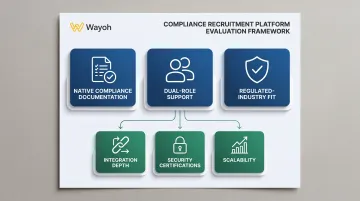
Three criteria drove the evaluation, all specific to healthtech's dual-requirement environment:
- Native compliance documentation — does the tool handle EEOC records, audit trails, and structured evaluation natively, or does it require manual workarounds?
- Dual-role support — can it handle both technical hiring velocity and the credential-tracking needs of compliance-heavy positions in the same workflow?
- Regulated-industry fit — is it adopted by or purpose-built for organizations operating under healthcare-adjacent regulatory frameworks?
Beyond those three, each tool was also evaluated on integration depth (HRIS, background screening, payroll), security certifications (SOC 2, ISO 27001, HIPAA-aware architecture), and scalability from early-stage to enterprise.
A common mistake is selecting tools built purely for tech startups or purely for clinical healthcare. Neither handles healthtech's combination of both.
Wayoh places compliance, risk, and regulatory professionals across regulated industries — including healthtech — and has seen directly which workflows produce clean documentation and which create audit gaps. This list reflects that operational perspective alongside feature analysis.
Conclusion
Choosing a recruitment tool for healthtech is, at its core, a risk management decision. The right platform makes compliance a byproduct of normal hiring activity: EEOC data collected automatically, interview decisions documented consistently, audit trails generated without manual effort.
Before committing to any platform, evaluate it against your specific obligations:
- Which frameworks apply — EEOC, FCRA, JCAHO, SOC 2?
- Do your clinical hiring managers need a simpler interface than your HR team?
- Is credential tracking a priority, or primarily interview documentation?
A tool that generates workarounds because it's too complex to adopt consistently is more dangerous than a simpler one used correctly.
Technology handles the workflow, but it can't evaluate candidates. Placing compliance officers, regulatory affairs specialists, and clinical informaticists in healthtech roles requires human expertise, industry relationships, and a clear sense of what "qualified" actually means in a regulated environment — context no software provides.
Wayoh is a recruiting firm focused on regulated-industry hiring across healthtech, fintech, and banking, with over a decade of experience and 500+ placements. If you're building out a compliance, regulatory, or technical team in a digital health organization, reach out at hiring@wayoh.com (employers) or apply@wayoh.com (candidates).
Frequently Asked Questions
What is the best staffing software?
The best option depends on your organization's size and compliance obligations. Greenhouse and SmartRecruiters suit mid-size tech-adjacent teams that need structured workflows without full HCM investment. iCIMS and Workday serve larger enterprises with complex, multi-framework compliance requirements and deeper integration needs.
What are the compliance requirements for healthcare hiring?
Healthtech employers must satisfy EEOC recordkeeping (one-year minimum for all hiring records), FCRA requirements for background checks including pre-adverse action procedures, and JCAHO or state licensing standards for clinical roles. Note that HIPAA does not govern employment records — that burden falls under EEOC and applicable state law.
What technologies are used in the recruitment process?
The main categories are applicant tracking systems (ATS) for pipeline management, AI-powered screening and matching tools, background check and credentialing platforms, interview intelligence software like Metaview, and HRIS integrations that connect hiring data to onboarding and payroll without creating data silos.
What are the best AI tools for streamlining recruitment workflows?
Metaview leads for interview documentation and structured feedback capture. Greenhouse includes AI screening capabilities across its tiers. Workday's Illuminate platform and the HiredScore acquisition add skills-based candidate matching with built-in bias mitigation protocols.
What are the 4 pillars of recruiting?
The four phases are sourcing, screening, selection, and onboarding. In healthtech, each carries distinct compliance obligations — from FCRA disclosures at screening to credential verification at onboarding.