For banks and fintechs alike, the question isn't whether to prioritize KYC management. It's whether they have the right talent to do it properly.
This article covers what KYC management actually involves, the roles required to execute it, why qualified professionals are increasingly hard to find, and how institutions can build teams that hold up under regulatory scrutiny.
TL;DR
- KYC management is a mandatory, ongoing compliance function covering customer identification, due diligence, and transaction monitoring under the Bank Secrecy Act.
- Effective programs require specialized professionals — KYC Analysts, BSA/AML Officers, Compliance Managers, and EDD Specialists — not just technology platforms.
- Labor accounts for 67% of financial crime compliance costs in the U.S. and Canada, making staffing decisions central to program economics.
- Banks and fintechs have different KYC talent needs, but both face the same shortage: professionals who understand both regulation and compliance technology.
- Permanent and contract staffing serve different purposes; choosing the right model for each situation directly affects program cost and speed.
What Is KYC Management?
KYC management is the structured, ongoing process through which financial institutions verify customer identities, assess risk, and monitor account activity to prevent financial crime. It spans policies, people, and controls across the entire customer lifecycle — from initial onboarding through the duration of the relationship.
The legal foundation sits in the Bank Secrecy Act (31 USC 5318), which requires U.S. financial institutions to maintain active AML/KYC programs. FinCEN administers the BSA and has authority to issue regulations, guidance, and enforcement actions. Coverage extends well beyond traditional banks. Institutions required to comply include:
- Commercial and community banks
- Money services businesses (MSBs)
- Broker-dealers and mutual funds
- Fintech companies operating as money transmitters
Across all of these institution types, KYC is an ongoing obligation — not a one-time check. FinCEN's 2016 CDD Rule, effective May 2018, established continuous customer due diligence as the fifth pillar of an AML program. That makes ongoing monitoring a regulatory requirement, not a best practice. Technology can assist, but trained professionals remain accountable for the judgment calls that automated systems can't make.
Non-compliance carries real consequences. In October 2024, TD Bank received a combined $1.3 billion FinCEN penalty plus $450 million OCC civil money penalty for systemic BSA/AML failures — along with an unprecedented asset cap restricting future growth.
The Core Components of a KYC Program
KYC management breaks down into five distinct operational stages, each with its own regulatory basis and specific staffing demands. Knowing what each stage requires is what separates a functional compliance team from one that's perpetually understaffed in the wrong places.
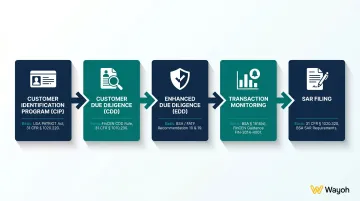
Customer Identification Program (CIP)
The CIP is the foundational entry point. Under 31 CFR 1020.220 — enacted through Section 326 of the USA PATRIOT Act — institutions must collect and verify four data points for every new account holder:
- Full legal name
- Date of birth
- Address (residential or business)
- Government-issued identification number
The CIP must also include screening against government watchlists for known or suspected terrorists. This stage is where KYC Analysts spend the bulk of their time at volume-driven institutions.
Customer Due Diligence (CDD) and Enhanced Due Diligence (EDD)
CDD goes deeper than identity verification. It requires understanding who the customer is and what risk they represent — analyzing transaction patterns, source of funds, business type, and associated entities. FinCEN's 2016 CDD Rule added a fifth mandatory requirement: identifying and verifying any individual who owns 25% or more of a legal entity customer, plus at least one controlling person.
EDD applies to high-risk customers — politically exposed persons (PEPs), customers from sanctioned jurisdictions, businesses in high-risk industries, or those with unusual transaction structures. The work at this level is substantively different from standard CDD:
- Adverse media and litigation record searches
- International corporate registry checks
- In some cases, physical site visits
These investigations require analysts with a distinct skill set from those handling routine CDD reviews.
Ongoing Transaction Monitoring and SAR Filing
Transaction monitoring is where KYC intersects directly with active AML. Institutions continuously review account behavior for red flags: unusual deposit patterns, cross-border activity, and connections to sanctioned entities.
When suspicious activity is identified, institutions must file a Suspicious Activity Report (SAR) with FinCEN within 30 calendar days of becoming aware of it (for transactions involving at least $5,000). The scale of this obligation is significant: FinCEN received approximately 4.7 million SARs in FY2024, with depository institutions filing 54% of all reports.
Accurate SAR filing requires professionals who understand both the evidence threshold and the regulatory reporting requirements. This is not a function that tolerates gaps in staffing or expertise.
Critical KYC Roles Banks and Fintechs Need to Fill
KYC compliance is ultimately a people function. Technology can flag anomalies and automate document collection, but humans interpret risk, exercise judgment, and are accountable to regulators. Here are the roles that matter most.
KYC Analyst
The frontline of any KYC program. KYC Analysts handle CIP reviews, watchlist screening, documentation collection, and escalation of flagged accounts. Core requirements include attention to detail, familiarity with identity verification tools, and working knowledge of BSA/AML requirements. At fintechs with high onboarding volume, this role is often the first hire and the most frequently needed at scale.
BSA/AML Officer
Federal regulations — specifically 12 CFR 21.21 (OCC), 12 CFR 208.63 (Federal Reserve), 12 CFR 326.8 (FDIC), and 12 CFR 748.2 (NCUA) — require every depository institution's board of directors to designate a qualified BSA compliance officer. This isn't optional. The BSA Officer owns the AML program, oversees SAR filings, manages examiner relationships, and reports compliance status directly to the board.
CAMS certification (Certified Anti-Money Laundering Specialist) is the benchmark credential for this role. ACAMS reports over 65,000 CAMS-certified professionals globally — yet demand consistently outpaces that supply across U.S. depository institutions.
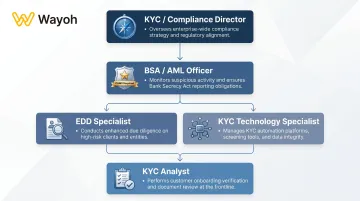
KYC/Compliance Manager or Director
The operational and strategic lead. This person builds and trains the KYC team, coordinates with audit and legal, and translates compliance requirements into executable programs. Policy updates in response to regulatory changes fall squarely in this role's remit. CAMS or equivalent credentials are typically expected at this level, along with meaningful experience managing both people and regulators. Fintechs building programs from scratch need this hire early.
EDD and High-Risk Account Specialists
These professionals handle the most complex investigations — cases that standard CDD workflows aren't designed for. Backgrounds in law enforcement, foreign financial systems, or financial intelligence are common and valued. Fintechs entering international markets or serving high-risk verticals have especially high demand for this expertise.
KYC Technology and Data Specialists
A growing and underserved category. The role blends regulatory knowledge with technical fluency — and most institutions struggle to find candidates who cover both credibly. Core responsibilities include:
- Managing automated monitoring platforms and alert workflows
- Tuning detection thresholds to reduce false positive rates
- Interpreting system outputs and escalating meaningful findings
- Bridging compliance requirements and technology implementation
Finding candidates with genuine depth in both areas is one of the harder searches in this market. Wayoh's compliance hiring practice is built around exactly this profile — professionals with regulatory grounding and hands-on operational tech experience.
The KYC Talent Challenge: Why Hiring Is Getting Harder
The demand for qualified KYC professionals is rising faster than the supply of people who can actually do the work.
The Supply-Demand Reality
The U.S. had approximately 418,000 compliance officer jobs in 2024, according to the Bureau of Labor Statistics, with a projected growth rate of 3% through 2034. That projection covers compliance broadly — the actual demand pressure within AML and KYC financial services roles is far more concentrated.
ACAMS has noted that enforcement activity and stronger economic conditions are actively driving demand for AML professionals, with expanding enforcement scope creating urgency well beyond traditional banking.
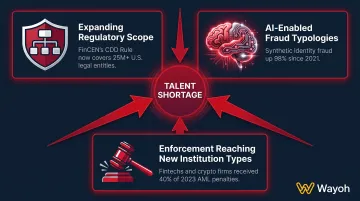
Several factors are tightening the market simultaneously:
- FinCEN's expanding beneficial ownership requirements raise the knowledge bar for all KYC staff
- AI-enabled fraud tactics are creating new typologies that require experienced analysts to recognize
- Enforcement actions are reaching new institution types — FinCEN's February 2025 $37 million penalty against Brink's Global Services was its first-ever action against an armored car company, signaling that no regulated entity operates outside of scrutiny
Together, these pressures produce shallow candidate pipelines for senior roles, long time-to-fill cycles for BSA Officer and Compliance Director positions, and intensifying competition for EDD specialists with real investigative experience.
The Cost of Getting It Wrong
An underqualified compliance hire isn't just a performance problem : it's an institutional risk. The TD Bank enforcement action is the clearest recent example: systemic BSA/AML failures, including inadequate staffing and poor customer due diligence, resulted in a combined $1.75 billion in penalties, an asset cap, and restrictions on opening new branches or entering new markets.
Beyond monetary penalties, consent orders impose ongoing compliance costs, reputational damage, and operational constraints that can last years.
Why General Recruiting Falls Short
KYC roles require domain knowledge that generic job boards and non-specialist recruiters aren't equipped to evaluate. A candidate may list "AML experience" on a resume while having never written a SAR narrative or managed an exam response. That gap between paper credentials and practical regulatory judgment is precisely what shows up when examiners start asking questions.
Wayoh's relationship-led recruiting model addresses this directly. Rather than filtering by keywords, the team conducts substantive conversations to assess regulatory exposure, situational judgment, and fit for the institution's risk environment — screening for the kind of experience that only shows under pressure.
Banks vs. Fintech: How KYC Staffing Needs Differ
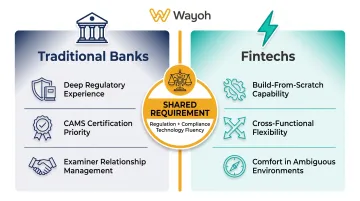
Banks and fintechs both run KYC programs — but the talent profiles, hiring pressures, and compliance structures look quite different between them.
Traditional banks operate within established compliance frameworks — dedicated departments, formal exam cycles, long-standing BSA programs. Their hiring tends to prioritize:
- Deep regulatory experience and CAMS certification
- Institutional tenure and examiner relationship management
- Candidates who can navigate existing structures and defend established programs
Fintechs face different pressures. They often scale rapidly, onboard customers digitally at volume, and may operate across multiple jurisdictions before their compliance infrastructure has matured. Their KYC talent needs are typically more dynamic:
- Professionals who can build programs from scratch without heavy infrastructure
- Cross-functional flexibility — compliance professionals who can work alongside product, engineering, and legal
- Comfort operating in ambiguous, fast-moving environments while maintaining regulatory integrity
When fintechs partner with banks to deliver deposit products, the bank retains full BSA/AML responsibility. The July 2024 joint statement from the Federal Reserve, FDIC, and OCC is explicit: a bank's use of a third party doesn't reduce its own compliance obligations. Banks entering fintech partnerships need to staff accordingly — not assume the fintech handles it.
That shared accountability is also where talent demand converges. Both banks and fintechs increasingly need KYC professionals who understand regulation and the technology systems used to run compliance operations. That overlap is where the most competitive hiring is happening right now.
Permanent vs. Contract: Choosing the Right KYC Staffing Model
Not every KYC hiring need requires a permanent placement, and not every compliance gap can wait for a six-month search. Knowing which model to use and when to use it is a practical advantage.
Permanent hiring fits best when:
- The role carries regulatory accountability (BSA Officer, Compliance Director)
- Program continuity and institutional knowledge are critical
- The position involves managing examiner relationships or board reporting
- Long-term cultural integration matters
Contract or interim staffing fits best when:
- A regulatory remediation project requires immediate capacity
- An exam finding has created a backlog in transaction monitoring or KYC reviews
- A new product launch requires temporary compliance support without permanent headcount
- A system transition needs qualified professionals during the changeover period
- Leave coverage is needed for a critical compliance role
Wayoh supports both models. For banks managing regulatory remediation timelines or fintechs scaling through a product launch, interim KYC and AML professionals are fully vetted with references and background checks before placement, not sourced from a generic database on short notice.
All interim consultants are covered with transparent conversion terms from day one, giving institutions the option to bring strong performers into permanent roles when it makes sense.
A blended staffing approach works because it separates urgency from permanence — you can move fast on an interim hire without locking in headcount, then convert selectively when the fit is proven. With over a decade of compliance and risk hiring experience and 500+ professionals placed, Wayoh gives banks and fintechs the reach to staff up or scale back on their own timeline.
Frequently Asked Questions
What is KYC management?
KYC management is the structured process through which financial institutions verify customer identities, assess risk levels, and monitor account activity on an ongoing basis. It exists to prevent financial crime and satisfy regulatory obligations under the Bank Secrecy Act and related regulations.
What are the 5 stages of KYC?
The five stages are:
- Customer Identification Program (CIP)
- Customer Due Diligence (CDD)
- Enhanced Due Diligence (EDD) for high-risk customers
- Ongoing Transaction Monitoring
- Suspicious Activity Report (SAR) filing with FinCEN
What are the 4 key elements of KYC policy?
The four elements are:
- Customer Acceptance Policy
- Customer Identification Procedures (CIP)
- Ongoing Transaction Monitoring
- Risk management framework for updating customer risk profiles
Is KYC mandatory for financial institutions in the USA?
Yes. KYC is mandatory under the Bank Secrecy Act and the USA PATRIOT Act for banks, broker-dealers, mutual funds, money services businesses, and other covered institutions. Oversight is shared across FinCEN, the OCC, FDIC, Federal Reserve, and FINRA.
What is due diligence in AML/KYC?
Due diligence refers to gathering and evaluating information about a customer to assess their risk level. Customer Due Diligence (CDD) applies to all customers; Enhanced Due Diligence (EDD) applies to those identified as higher risk based on their profile, geography, or transaction patterns.
What are the 4 pieces of CIP?
The four required data points are: full legal name, date of birth, address, and a government-issued identification number — the minimum requirements under 31 CFR 1020.220 (Section 326 of the USA PATRIOT Act).