Introduction
Healthtech companies are caught in a bind most software sectors don't face. Demand for digital health products is accelerating — the U.S. digital health market attracted $10.1 billion in venture funding across 497 deals in 2024 — but the talent needed to build, secure, and keep those products compliant is scarce, expensive, and slow to hire through traditional channels.
That hiring gap has real consequences. Regulatory deadlines don't wait for 90-day recruiting cycles. A CMS interoperability mandate, an imminent SOC 2 audit, or an active ransomware incident demands specialized talent in days — not months. And finding someone who combines software engineering skills with genuine HIPAA fluency isn't a Google search away.
This guide covers the key questions healthtech hiring managers are working through:
- What digital health staff augmentation actually is
- Why traditional hiring consistently falls short in this sector
- Which roles healthtech teams most commonly augment
- What to look for in a staffing partner that actually knows the sector
TLDR
- Digital health staff augmentation embeds specialized external professionals into your team on a temporary or project basis, with full management control remaining in-house.
- Standard full-time searches take 49–71 days for health IT roles; compliance deadlines and product launches can't accommodate that timeline.
- Highest-demand augmented roles: EHR/FHIR integration engineers, healthcare data specialists, HIPAA-focused cybersecurity professionals, and telemedicine developers.
- Unlike outsourcing, augmentation keeps PHI access and work oversight in-house, which matters in regulated health environments.
- General tech recruiters rarely carry pipelines of compliance-aware digital health talent — regulated-industry experience in a staffing partner makes the difference.
What Is Digital Health Staff Augmentation?
Staff augmentation in digital health means bringing external professionals directly into your team — on a temporary, project-based, or interim basis — to fill specific skill gaps. The organization retains full management control over the work, the tools, and the data. The augmented professional functions as part of your team, not as a vendor delivering a service from a distance.
This model fits healthtech particularly well because the work often involves protected health information, regulatory workflows, and proprietary clinical data. Who has access to what, and how that access is managed, isn't something most healthtech leaders want to delegate to an outside vendor.
Augmentation vs. Outsourcing vs. Full-Time Hiring
The three models serve different needs:
| Model | Control | Best Fit | Risk in Regulated Health |
|---|---|---|---|
| Staff Augmentation | Internal | Short-to-medium term gaps, specialized roles | Low — you manage access and workflows |
| Outsourcing | External vendor | Fully delegatable, non-sensitive projects | High — compliance enforcement is harder |
| Full-Time Hiring | Internal | Ongoing, permanent functions | Low — but slow and expensive to execute |
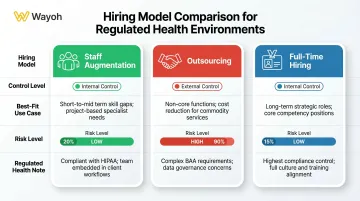
For healthtech companies handling PHI and navigating HIPAA, outsourcing creates a specific exposure: compliance oversight transfers to a vendor, which is a difficult position to defend in an OCR investigation. Retaining internal control over system access isn't optional — it's a regulatory posture. Full-time hiring makes sense when the need is permanent and the budget supports the full employment cost. When neither condition applies, augmentation gives you the control of direct employment without the overhead of a permanent hire.
Why Traditional Hiring Falls Short in Healthtech
The digital health talent market has a structural problem. The BLS projects 15% employment growth for health information technologists from 2024 to 2034 — triple the national average — while HIMSS has catalogued over 50 discrete health IT job titles requiring combinations of technical, clinical, and regulatory expertise. Supply isn't keeping up.
The Time-to-Fill Problem
Healthcare positions average 49 days to fill. Senior technology roles average 71 days. Compliance-aware engineering roles — where FHIR knowledge meets HIPAA fluency — combine both demands. You're looking at 70+ days before a permanent hire starts, and that's assuming you find the right candidate on the first attempt.
That timeline doesn't align with:
- CMS interoperability deadlines — FHIR API implementation windows are defined and non-negotiable
- Active security incidents — ransomware response can't wait two months for a new hire to onboard
- Product launch windows — a missed market window for a telehealth feature has real revenue consequences
- Compliance audit cycles — SOC 2 or HIPAA audits run on their own calendar, not yours
Specialized Roles That Generic Agencies Can't Fill
A software engineer who can implement HL7 interfaces, understands HIPAA's minimum necessary standard, and knows how to structure PHI handling in a cloud environment is a fundamentally different hire than a general full-stack developer. Generic staffing agencies don't maintain pipelines of professionals with this combination. They run keyword searches against job boards — a method that produces volume, not the vetted, compliance-aware candidates healthtech teams actually need.
Startup vs. Enterprise Dynamics
The scaling challenges differ significantly by organizational stage:
- Pre-Series B startups may need to grow from 3 to 15 engineers in a single quarter to hit a product milestone
- Health systems face intense, temporary demand during EHR migrations or telehealth rollouts — but don't want to carry that headcount once the project stabilizes
- Mid-stage healthtech companies need senior expertise for specific compliance or integration projects without committing to a permanent salary, benefits, and equity package
Each scenario shares one common constraint: the work can't wait for a 70-day hiring cycle. Staff augmentation is built for exactly that gap — providing vetted, specialized professionals when the timeline is set by the project, not the hiring process.
High-Demand Roles in Digital Health Staff Augmentation
Digital health platforms require a more specialized talent mix than general SaaS products — and knowing which roles get augmented most frequently helps leaders plan resourcing before the pressure hits.
Technical Roles Most Commonly Augmented
EHR Integration Engineers and HL7/FHIR Specialists
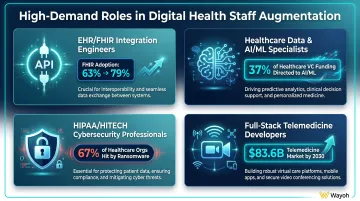
These professionals connect EHR systems to telehealth platforms, pharmacy networks, lab systems, and payer APIs. Demand spikes during CMS compliance windows and platform upgrades — FHIR adoption among EHR vendors jumped from 63% to 79% in a single year — then subsides once integrations stabilize. Short, high-intensity engagements are the norm, not the exception.
Healthcare Data Engineers and AI/ML Specialists
Predictive AI adoption in U.S. hospitals rose from 66% to 71% between 2023 and 2024, and AI-enabled startups captured 37% of total digital health venture funding in 2024. Building and operating these systems requires professionals who understand both data infrastructure and healthcare-specific formats — HL7, FHIR, ICD codes, and de-identification requirements under HIPAA. Most engagements are project-scoped, making permanent headcount a poor fit for the demand pattern.
Cybersecurity Professionals With HIPAA and HITECH Expertise
67% of healthcare organizations were hit by ransomware in 2024, nearly double the 34% rate reported in 2021. The average healthcare data breach costs $10.93 million — the highest of any industry. These specialists are needed for compliance audits, penetration testing, incident response, and ongoing security posture — often on a surge or contract basis rather than as a permanent headcount addition.
Full-Stack Developers With Telemedicine Experience
The U.S. telehealth market is projected to grow from $46.1 billion in 2024 to $83.6 billion by 2030. Building HIPAA-compliant video, scheduling, and messaging features requires engineers who understand both the technical stack and the regulatory constraints — a combination that many general developers simply don't have.
Compliance-Adjacent Roles
Non-engineering roles are increasingly part of augmented teams, especially at companies in active regulatory or growth phases:
- Health IT project managers — coordinating cross-functional builds and compliance timelines
- Regulatory analysts — supporting FDA Software as a Medical Device (SaMD) guidance and SOC 2 readiness
- Clinical informaticists — bridging clinical workflows with technical implementation on large-scale interoperability programs
Key Benefits for Healthtech Leaders
Speed Without Sacrificing Quality
A staffing partner with a pre-vetted talent pool places augmented professionals in days to weeks — not the 70+ days a typical specialized health IT search requires. For a product launch or compliance deadline, that gap can determine whether you hit your timeline or miss it.
Wayoh's network-first model, built on over a decade of relationships across regulated industries, surfaces passive candidates who aren't browsing job boards. These are the specialized professionals healthtech companies need but rarely find through standard recruiting channels.
Cost Control for Project-Specific Needs
Augmentation eliminates the costs that make permanent hiring expensive for short-to-medium-term needs:
- No benefits, equity, or severance
- No long recruiting cycle with uncertain outcomes
- Pay for the expertise during the period you need it
- Transparent conversion fees from day one if a temporary role becomes permanent
For earlier-stage healthtech companies, this matters. Senior HIPAA cybersecurity specialists and FHIR engineers command significant salaries. Augmentation provides access to that expertise without the indefinite financial commitment.
Flexibility Tied to Regulatory and Funding Cycles
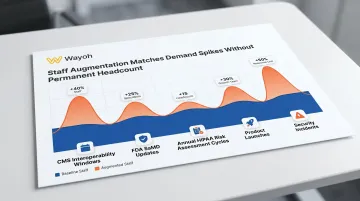
Healthtech workloads don't follow a steady-state curve. They spike around regulatory deadlines, product launches, funding milestones, and security incidents, then return to baseline. Staff augmentation lets teams scale up for a compliance audit cycle or EHR migration, then return to a leaner core once the peak passes.
This flexibility is valuable for companies navigating recurring, time-boxed demands — including:
- CMS interoperability compliance windows
- FDA SaMD guidance updates requiring clinical or technical review
- Annual HIPAA risk assessment cycles
Each of these generates defined, predictable demand for specialized talent. Augmentation matches that pattern without locking in permanent headcount.
Compliance and Risk Considerations
BAAs Are Not Optional
The moment an augmented professional accesses systems containing PHI, your HIPAA compliance boundary expands to include them. That triggers mandatory Business Associate Agreements — HHS has been explicit that this applies to staffing arrangements where placed workers access PHI. OCR has settled or imposed penalties in 143 cases totaling approximately $142.7 million, including 49 investigations specifically involving business associates.
A $650,000 settlement against Catholic Health Care Services and a $1.25 million penalty against Deer Oaks Geriatric Services both stemmed from inadequate safeguards — the same category of risk created by poorly managed augmented staff with PHI access.
The Right Compliance Framework for Augmented Teams
Before any augmented professional accesses your systems:
- Execute a signed BAA covering PHI and IP
- Apply role-based access controls limiting exposure to the minimum necessary
- Complete HIPAA onboarding before any PHI interaction
- Maintain audit-ready access logs for the full engagement duration
- Assign an internal point of contact to manage onboarding and access throughout
Managing Turnover Risk
Mid-engagement departures carry a specific cost in digital health: specialized clinical or compliance context takes weeks to rebuild when an augmented professional exits unexpectedly. Mitigate that risk by:
- Requiring structured knowledge transfer and documentation from day one
- Establishing clear offboarding procedures in the staffing contract
- Evaluating partners on retention track record, not just placement speed
- Choosing a partner that stays actively involved throughout the assignment — Wayoh's weekly check-ins with placed consultants are designed to catch friction early, before it becomes a departure
How to Choose the Right Digital Health Staffing Partner
Prioritize Regulated Industry Experience
A firm that has spent years placing compliance and risk professionals in banking, fintech, and healthcare knows what "compliance-aware" actually means in practice — not just whether a candidate lists "HIPAA" on a resume. Real assessment happens through structured conversations, reference checks, and sector-specific screening questions.
General tech staffing agencies can run keyword searches. What they can't do is evaluate whether a candidate truly understands PHI handling requirements, audit readiness, or the practical difference between HIPAA's Privacy Rule and Security Rule.
Questions to Ask Before Signing
Before engaging any staffing partner for digital health roles, ask:
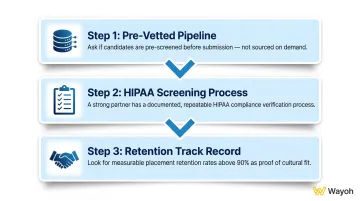
- Do you maintain a pre-vetted pipeline, or do you start cold after I engage you? A pre-vetted pipeline means faster, higher-quality placements — not a marked-up job board search.
- How do you screen candidates for HIPAA familiarity and regulated environment experience — not just technical skills? A credible answer describes real conversations and reference checks, not keyword matching.
- What is your retention track record for mid-engagement placements, and what do you do when a consultant isn't working out? Placement speed is irrelevant if continuity breaks down three months in.
Wayoh has over a decade of regulated industry experience, with 500+ placements spanning banking, fintech, and healthtech. That cross-sector background means recruiters can evaluate compliance readiness in context — not just match keywords — across key markets including New York, California, and Florida.
Frequently Asked Questions
What is digital health staff augmentation?
It's the practice of integrating external, specialized professionals into a healthtech team on a temporary or project basis. Your organization retains full management control while filling skill gaps in areas like EHR development, data engineering, cybersecurity, or compliance.
How much does digital health staff augmentation cost?
Costs vary based on role seniority, specialization, engagement duration, and the staffing partner's model. Contract rates may appear higher than a salary equivalent, but companies avoid benefits, equity, and long-term retention costs — making augmentation more economical for project-specific or surge needs.
What are examples of digital health staff augmentation?
Common scenarios include:
- A healthtech startup bringing in FHIR integration engineers for a six-month platform build
- A telehealth company adding a HIPAA cybersecurity specialist ahead of a compliance audit
- A health system augmenting its data engineering team during an EHR migration
How is digital health staff augmentation different from outsourcing?
Augmentation integrates external talent into your team under your management: you control access, workflows, and priorities. Outsourcing transfers project ownership to a vendor, reducing visibility and making compliance enforcement considerably harder in regulated health environments.
What roles are typically filled through digital health staff augmentation?
The most common include:
- EHR/HL7/FHIR integration engineers
- Healthcare data and AI specialists
- HIPAA-focused cybersecurity professionals
- Full-stack telemedicine developers
- Health IT project managers and regulatory analysts
How do healthtech companies maintain HIPAA compliance when working with augmented staff?
Key steps include:
- Require Business Associate Agreements before granting system access
- Apply role-based access controls tied to job function
- Complete HIPAA onboarding prior to any PHI exposure
- Maintain audit-ready access logs throughout the engagement