
Introduction
If your bank is still treating analyst recruiting as a fall activity, you've already lost ground. IB analyst hiring runs on a fixed annual cycle tied to the academic calendar—and unlike compliance, risk, or operations roles where at-need hiring is standard, there's no catching up once the window closes.
For banking firms planning their 2026 analyst class, the cycle has already begun. Bulge bracket banks launched networking events and early identification programs in mid-2025, and by March 2026, most major firms had already filled summer internship positions. Regional banks, boutiques, and community institutions that treat October as "early" are already behind the curve—top candidates have been forming preferences and locking in interviews for months.
This guide covers what banking firms at every tier—bulge bracket, boutique, regional, and community—need to plan and execute for the 2026 cycle. The focus is on what's actually changing: sophomore-year recruiting is now a reality at top programs, geographic competition has expanded well beyond New York, and firms are moving from generalist hiring toward coverage group specialization. Understanding these shifts is what separates firms that fill their classes from those that settle for second-choice candidates.
TL;DR
- Investment banking recruiting for 2026 roles began in mid-2025, with top-tier firms launching programs as early as July
- The full-time analyst pipeline runs almost entirely through summer internships; banks that miss this window face a thinner, harder-to-close candidate pool
- Bulge bracket banks follow rigid campus timelines; boutiques and regional banks have flexibility but often lose candidates by moving too slowly
- Networking and relationship-building are structural requirements—candidates use them to rank and prioritize which firms they pursue
- Banks competing in 2026 need a clear hiring plan, defined milestones, and access to both on-campus and passive candidate networks
What Is the Investment Banking Recruiting Process?
Investment banking recruiting is the structured process through which banks identify, screen, interview, and hire analyst and associate-level talent, typically through a formalized cycle tied to the academic calendar. Unlike general financial services hiring, which operates on an as-needed basis for individual vacancies, IB analyst recruiting runs on a fixed annual schedule designed to fill firm-wide intake classes.
The goal is to build a pipeline of qualified candidates before roles officially open, so offer decisions can be made quickly and efficiently across the entire analyst class during a narrow interview window. Banks hire approximately 2,000 IB analysts per year in the United States, drawn from a concentrated set of target and semi-target universities.
The process begins well before internships start — applications open approximately 18 months before the internship start date, during the fall of a student's sophomore year. This gives banks a head start on securing top candidates before competitors do, while building relationships that carry through multiple recruiting seasons.
Why This Structure Matters for Hiring Firms
The academic calendar dictates when candidates are available, leaving banks with fixed windows whether they're ready or not. The bottleneck is rarely candidate availability — it's internal readiness. Firms that fall behind on:
- Defining group headcount and role specs
- Aligning on interview formats and evaluators
- Getting requisition approvals through HR
...miss the window entirely and spend the next year backfilling with off-cycle hires at a premium.
The 2026 Investment Banking Recruiting Timeline: A Month-by-Month Breakdown
The 2026 recruiting cycle for summer internships and full-time analyst roles runs from approximately mid-2025 through early 2026. Banks that understand this timeline hold a structural advantage over those that treat it as a calendar formality.
The reason: the majority of full-time offers are pre-committed to returning summer interns. In practice, firms make most of their 2026 analyst class decisions during the June–August 2025 internship period — well before formal applications open.
Bulge bracket banks were promoting 2026 opportunities and early identification programs by September 2025, meaning mid-market and regional banks must have their hiring strategy defined by the same window or risk losing top candidates early.
Phase 1: Early Engagement (July – September 2025)
July through September is when candidates start sorting their shortlists. Firms host on-campus info sessions, coffee chats, and virtual recruiting events. Early identification and diversity programs open applications, and brand perception formed in this window carries into screening decisions months later.
What Banks Should Be Doing Operationally:
- Define target schools and establish campus presence through alumni networks
- Identify coverage group needs and forecast headcount by division
- Brief recruiters on firm culture, deal flow, and group-specific opportunities
- Launch early identification programs targeting first-year and sophomore students
Early ID Programs Already in Market:
Major banks operate structured programs well before the main recruiting cycle:
| Bank | Program Name | Target Year | Application Window |
|---|---|---|---|
| Goldman Sachs | Possibilities Series | First-year undergrads | November deadline |
| JPMorgan | Career.edYOU Academy | Sophomore | Fall 2025 |
| Morgan Stanley | Early Insights Programme | First-year/Sophomore | Fall 2025 |
| Jefferies | Class of 2028 Insight Day | Sophomore | October 2025 |
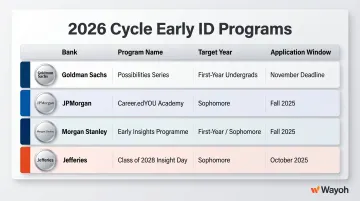
These programs were operational by July–September 2025 for the 2026 cycle, with application windows opening in the fall preceding the program year.
Phase 2: Applications and Screening (September – November 2025)
Major firms open formal applications between September and November 2025, often reviewed on a rolling basis—meaning late applications face structural disadvantage even if the window remains technically open.
Screening Tools Commonly Used:
- HireVue one-way video interviews
- Online technical assessments (accounting, valuation, financial modeling)
- Recruiting team review of submitted resume books
- Referral-based shortlisting from alumni networks
Banks that delay screening past November risk losing candidates to faster-moving competitors. In a rolling-review environment, a 48-hour response window can be the difference between locking in a top candidate and watching them accept elsewhere.
Phase 3: Interviews, Superdays, and Offers (November 2025 – February 2026)
Candidates who pass screening are invited to Superday interviews: back-to-back sessions with multiple bankers in a single day, assessing both technical finance knowledge and behavioral fit. Most MBA on-campus decisions wrap up by December, with undergraduate Superdays and offers extending into January–February 2026.
Firms that delay past this window face a shrinking pool. Elite banks are increasingly extending lateral analyst and associate offers in Q4 — November and December — ahead of the traditional post-bonus season in February and March. Mid-market and regional firms that wait for spring find the strongest candidates already committed.
Timeline Compression in Practice:
By March 2026, the Summer 2026 hiring season was largely closed for most major firms. Banks that began outreach in early 2026 were competing for a pool that had already been worked for six months — with the strongest candidates long off the market.
How Timelines Differ Across Bank Types
Not all banks operate on the same recruiting calendar, but the differences create strategic trade-offs rather than advantages.
Bulge Bracket Banks
Bulge bracket banks (Goldman Sachs, JPMorgan, Morgan Stanley) run the most rigid campus recruiting timeline and hire almost exclusively through structured class programs at target schools. Large banks now conduct junior-year summer internship recruiting during a student's sophomore year, with interviews and Superdays occurring in April and May of the second year. In documented cases, banks went from filling 50% of their intern classes with sophomores to filling 100% within a single cycle.
Bulge brackets dictate the market pace. Regional and boutique banks cannot ignore this timeline—it sets candidate expectations for when offers should arrive.
Elite Boutiques and Middle-Market Banks
With bulge brackets anchoring candidate expectations, elite boutiques and middle-market banks follow a similar but slightly later timeline, often running Superdays in January–February. They hire outside target schools more frequently, giving regional candidates a viable path in. That said, approximately 120 firms concentrate recruiting activity from January through March of sophomore year, so the window is still narrow.
Community Banks, Regional Institutions, and Smaller Boutiques
These firms operate on a need-based model with no fixed recruiting calendar, creating flexibility but also risk. Regional and smaller boutique banks tend to wait to post positions until after the first round of BB/MM/EB recruiting has concluded—typically after the spring semester of sophomore year.
This timing creates a compounding problem. When bulge bracket firms extend offers 18 months ahead of start dates, banks that begin recruiting even a few months later find the candidate pool already thinned by faster-moving competitors. Need-based recruiting isn't inherently wrong — but without awareness of the broader cycle, smaller institutions often lose their top candidates before posting a single job.
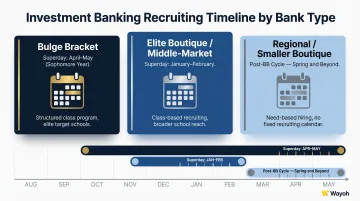
| Bank Type | Superday Timing | Recruiting Model |
|---|---|---|
| Bulge Bracket | April–May (sophomore year) | Structured class program |
| Elite Boutique / Middle-Market | January–February | Class-based, broader school reach |
| Regional / Smaller Boutique | Post-BB cycle (spring+) | Need-based, no fixed calendar |
Key Factors That Shape IB Recruiting Outcomes in 2026
Several structural factors determine which banks successfully compete for top talent and which consistently arrive too late.
Candidate Pipeline Access
Banks relying solely on on-campus portals compete for a visible, heavily contested pool. Firms that build direct relationships before applications open—or partner with specialist recruiters who operate network-first—reach passive candidates who aren't actively applying. The best banking talent is found through personal networks, not job boards.
Regional and boutique banks without established campus presence face a real disadvantage here, unless they offset it through alumni engagement or recruitment partnerships that surface off-market candidates.
Target School Concentration vs. Geographic Expansion
Top banks are increasingly recruiting beyond New York into Charlotte, Chicago, Miami, and San Francisco. Goldman Sachs is constructing an 800,000 square foot campus in Dallas that will house more than 5,000 employees across all divisions, with IB leadership presence outside New York.
This expansion broadens the talent pool and requires campus relationships in new markets. Regional banks in these growth cities hold a geographic edge — yet they still have to compete on brand recognition, compensation, and hiring speed to convert that advantage into offers accepted.
Practice Group-Specific vs. Generalist Hiring
Many banks have shifted away from generalist analyst pools toward direct hiring into coverage groups such as Technology, Healthcare, and Energy. This shift builds expertise from day one but requires banks to signal group-specific opportunities early and recruit candidates with clear industry orientation.
For smaller banks, the tension is real: generalist hiring preserves flexibility, yet candidates increasingly want a defined coverage group assignment before they sign. Banks must communicate what candidates will work on, not just where they'll sit.
Internship-to-Offer Conversion Rates
A significant share of full-time analyst slots are pre-filled by returning interns. Return offer rates vary widely by bank type:
| Bank Category | Reported Return Offer Rate |
|---|---|
| Elite Boutiques | 90–100% |
| Bank of America | ~90% |
| Middle-Market M&A | 75–80% |
| Bulge Bracket Coverage | ~65% |
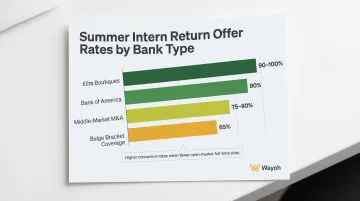
Banks with strong conversion programs need fewer external hires; those with low conversion rates face more pressure on the open market in a compressed window. Firms without structured internship programs must rely entirely on full-time recruiting or lateral hiring — both more competitive and unpredictable.
Speed of Decision-Making
In a rolling-review cycle, banks that take longer than two weeks to move candidates from screening to offer lose qualified candidates to faster-moving competitors. Time-to-hire is rising across industries and approaching 2019 levels, with delays driven by:
- Multiple approval layers that stall decisions
- Misalignment between recruiters and hiring managers
- Unclear evaluation criteria
- Slow internal feedback loops
In IB's compressed recruiting windows, internal delays of even days — not weeks — can result in losing candidates who accept competing offers. The banks that win are those with pre-approved hiring authority, clear evaluation rubrics, and decision-makers who can move within 48–72 hours of a Superday.
Common Pitfalls in Investment Banking Recruitment
Starting Outreach Too Late
Banks that begin outreach in October or November—treating that as "early"—are already behind the curve. By that point, bulge bracket firms have been running info sessions, coffee chats, and early ID programs for months, and top candidates have formed preferences. The window for making a first impression closes faster than most regional banks anticipate.
Ignoring the Lateral and Experienced-Hire Market
Treating IB recruiting as purely a campus-recruitment exercise ignores the lateral market—analysts with 2–3 years of experience who want to switch firms or move from boutique to bulge bracket. Elite banks are aggressively poaching lateral talent from peers, focusing on candidates with experience in transactions over $1 billion and AI-themed deals.
For smaller banks, the lateral pipeline is a viable alternative to the campus cycle. These candidates offer distinct advantages — but the bar is real:
- Bring proven deal skills and require less ramp-up time than new graduates
- Can often start within weeks rather than months
- Face structured, deal-by-deal interviews testing whether they actually led key components — not just supported them
Internal Preparation Failures
Firms frequently underestimate the role of internal preparation. Unclear job specs, undefined group needs, or slow internal approvals can collapse an otherwise well-timed recruiting process. The bottleneck is often not candidate availability but internal readiness.
Checklist for Internal Readiness:
- Coverage group needs defined by Q3 of the prior year
- Headcount targets approved and budgeted
- Hiring managers briefed on timeline and decision authority
- Compensation bands benchmarked against competitors
- Superday logistics and interviewer availability confirmed
- Offer approval process streamlined to 48-hour turnaround
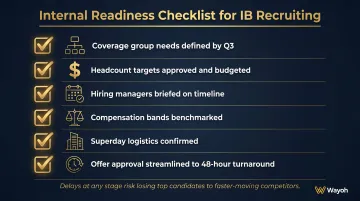
Banks that delay any of these steps risk arriving to market unprepared, even if their timeline is otherwise competitive.
Frequently Asked Questions
What is the investment banking recruiting timeline for 2025?
The 2025–2026 IB recruiting cycle begins in summer 2025 with networking and early identification programs, moves into formal applications by September–November 2025, and concludes with Superdays and offer decisions between November 2025 and February 2026. By March 2026, most major firms will have filled summer internship positions.
How does investment banking recruiting work?
Recruiting follows a structured sequence: networking and early identification programs, formal applications and screening, first-round interviews, and Superday finals. Most full-time offers flow through the summer internship pipeline, with high-performing interns receiving return offers in August.
How competitive is investment banking recruiting?
IB roles at top firms are among the most competitive in finance. Acceptance rates at elite investment banks are less than 1%, with competition at record highs. Banks hire approximately 2,000 analysts per year in the U.S. from a concentrated set of target schools, creating intense competition for a limited number of seats.
Is a 3.6 GPA bad for investment banking?
Most bulge bracket banks use GPA as a screening filter, with 3.5+ commonly cited as a floor for target schools. A 3.6 GPA from a target school is generally competitive if accompanied by strong networking and technical preparation. Boutique and regional banks weigh GPA alongside experience, networking strength, and technical ability—GPA is one factor, not the only one.
Is 25 too old for investment banking?
25 is not too old. MBA programs place graduates aged 27–28 into associate roles, and career changers entering through MBA or direct lateral paths are common. Age is rarely a barrier if the candidate has the right skills, story, and technical preparation. Goldman Sachs recruits associates primarily in their mid-to-late 20s, making 25 younger than the typical MBA-level IB candidate.
Which universities do top investment banks recruit from?
Top banks recruit from "target schools" with established alumni networks and hiring pipelines. Core targets include Wharton, Harvard, Stanford, MIT, NYU Stern, Michigan Ross, UC Berkeley Haas, and Georgetown McDonough. Semi-targets such as WashU Olin and UNC Kenan-Flagler are viable; non-target candidates can break in through aggressive networking and boutique firm pathways, but face steeper odds.
For banking firms building analyst pipelines in 2026 and beyond, the timeline compresses earlier each year. Internal preparation matters as much as external branding. Whether you're a bulge bracket refining your process or a regional bank entering structured recruiting for the first time, understanding the timeline is the starting point. How you execute it determines what you actually build.