
Introduction
Banking operations specialists—the professionals executing transaction processing, KYC, payment operations, and regulatory reporting behind every deposit, loan, and wire transfer—are under more hiring pressure than ever before.
These back-office roles, once viewed as transactional and stable, have become competitive flashpoints as banks navigate escalating regulatory scrutiny, infrastructure modernization, and AI-driven workflow integration.
The shifts are structural, not cyclical. Record regulatory fines, the launch of real-time payment networks, and T+1 settlement adoption have redefined what banks need from operations talent. Where generalist ops staff once sufficed, institutions now require specialists fluent in BSA/AML frameworks, instant payment rails, and automation platform oversight.
For hiring managers, the challenge is finding candidates with the right blend of compliance knowledge, technical fluency, and operational experience before competitors do. With finance-sector unemployment near historic lows and fintechs competing on compensation, the window to secure strong operations candidates has narrowed.
This guide covers:
- What banking operations specialists actually do and why the role has evolved
- Current hiring trends and demand signals across retail, commercial, and digital banking
- The skills and credentials institutions are prioritizing right now
- How to build a hiring strategy that works in a tight, specialized talent market
TL;DR
- AML, BSA, and compliance operations roles are growing fastest — across community banks, commercial lenders, and digital-first institutions alike
- AI and automation raise the technical bar for ops specialists rather than eliminate jobs
- Instant payments and T+1 settlement have opened new subspecialties in treasury and post-trade operations
- Unemployment in financial operations is at multi-year lows — experienced specialists regularly field competing offers
- Job-board-only hiring strategies are costing banks offers to faster-moving FinTechs and non-bank competitors
The Compliance-Operations Convergence Is Fueling Financial Crime Ops Hiring
The traditional divide between compliance and operations teams is collapsing. Banks increasingly need operations specialists who understand BSA/AML obligations, KYC workflows, and regulatory reporting requirements—not just transaction processing. Regulatory intensity has reached the point where back-office staff must operate within tightly defined compliance frameworks or risk exposing institutions to enforcement actions.
The numbers make this urgency clear. Global regulatory fines reached a record $19.3 billion in 2024, with AML and governance themes prominent. In the U.S., FinCEN assessed a $1.3 billion civil penalty against TD Bank for BSA violations in October 2024, while the Federal Reserve separately fined TD Bank $123.5 million for AML control failures. Implementation of new regulations like CFPB Section 1071 has further escalated compliance costs, with the ABA estimating $6.87 billion in one-time industry-wide costs and $1.95 billion in ongoing annual expenses.
Job titles reflect this shift. Roles once considered hybrid afterthoughts are now distinct, in-demand positions with defined scope:
- AML Operations Analyst — manages transaction monitoring queues and investigates alerts
- KYC Operations Specialist — owns onboarding workflows and ongoing due diligence reviews
- Financial Crime Operations Manager — coordinates SAR filings, regulatory reporting, and team throughput
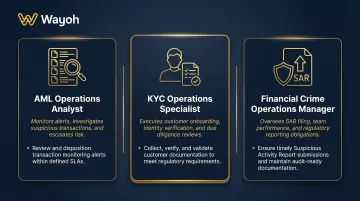
These professionals bridge compliance mandates and day-to-day operational workflows simultaneously.
The challenge for hiring teams is acute: candidates previously hired for "operations" experience now need working knowledge of federal compliance frameworks.
The ACAMS Global AFC Threats Report (2025) surveyed 1,500+ anti-financial crime professionals and found accelerating regulatory change and AI-driven threats outpacing institutional adaptability—with staffing and capability gaps flagged as the most pressing concerns.
This trend hits community banks and regional institutions hardest. Historically, these institutions relied on generalist ops staff who handled multiple functions. Today, they face the same regulatory scrutiny as larger banks but with smaller talent pools and tighter budgets. Specialized hiring is now a baseline requirement, not a strategic luxury. For community and regional banks, that often means working with a staffing partner who already knows the candidate market—because open job postings rarely surface professionals with this specific combination of ops execution and compliance depth. Wayoh works directly with experienced financial crime operations professionals across community, commercial, and digital banking, giving hiring teams a faster path to the right candidates.
AI and Automation Are Raising the Bar for Ops Specialists—Not Replacing Them
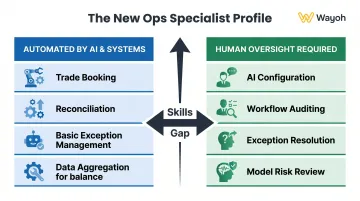
Automation is handling high-volume, repetitive tasks—trade booking, reconciliation, basic exception management—but it's simultaneously creating demand for operations specialists who can configure, audit, and manage those automated systems. The shift is from "doing the transaction" to "overseeing the system that processes transactions," and that requires a different skill set entirely.
According to Accenture's Banking Top 10 Trends 2024, approximately 73% of banking work is suited for automation or augmentation (39% automation, 34% augmentation), and generative AI can lift operational productivity by 22-30%. Yet only 26% of bank CEOs have a future-ready people strategy—leaving a gap between the tools being deployed and the people needed to run them.
The new profile emerging across operations functions blends process knowledge with technical fluency. Banks need people who can query data, configure automation platforms, interpret workflow logic, and handle exceptions that automated systems flag but can't resolve. Not pure technologists—but not purely transactional processors either.
This creates real hiring tension. Most applicants in the existing ops talent pool were trained in manual workflows and lack fluency with the tooling banks now require.
A Treasury Department RFI on AI in financial services cited a direct shortage of staff with sufficient knowledge to identify risks and biases in AI technologies—pointing to concrete demand for AI governance and model oversight capabilities within compliance-ops teams.
Compensation reflects this scarcity. The Robert Half 2026 Salary Guide reports that 87% of finance and accounting leaders pay premiums for specialized skills, with compliance and treasury roles outpacing average salary growth. That competition for tech-fluent ops professionals has spread well beyond large institutions—community banks, digital banks, and fintech-adjacent firms are all chasing the same shrinking pool.
Banks face a choice: retrain internally or compete externally for candidates with both operational and technical fluency. Those that partner with specialist recruiters who understand the domain—not just the job title—tend to move faster. Wayoh has spent over a decade building relationships with experienced operations candidates across banking and fintech, placing 500+ professionals in roles that rarely surface on job boards.
Instant Payments Adoption and T+1 Settlement Are Generating New Treasury and Post-Trade Ops Roles
The expansion of real-time payment networks and the shift to T+1 settlement in U.S. securities markets have created new operational demands. Banks now need treasury operations, cash management, exception handling, and collateral optimization roles that require near-real-time processing capabilities and cannot tolerate the error margins acceptable under prior settlement timelines.
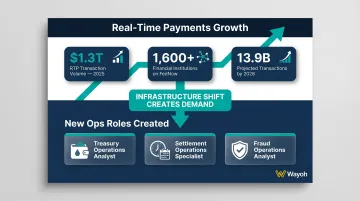
Adoption is accelerating rapidly. The Clearing House's RTP network recorded total payment value of $246 billion in 2024 and more than $1.3 trillion in 2025—a 428% increase. The Federal Reserve's FedNow network went live with more than 1,600 financial institutions across all 50 states, with approximately 450% year-over-year volume growth. Analysts project U.S. real-time payment transactions will reach about 8 billion in 2026 and 13.9 billion by 2028, a 31.7% compound annual growth rate.
T+1 settlement has reshaped post-trade operations. The SIFMA, ICI, and DTCC T+1 After Action Report highlights that affirmation performance improved from 73% in January 2024 to nearly 95% meeting the 9 pm ET trade-date cutoff, while NSCC Clearing Fund requirements fell by an average of $3.0 billion (23%). These gains required institutions to hire or retrain treasury and post-trade operations specialists who could execute affirmations, manage collateral, and resolve exceptions within compressed windows.
Faster payments mean faster fraud. Real-time rails have elevated fraud and AML risk, driving additional hiring for operations specialists in payment monitoring, APP fraud prevention, and identity verification workflows. The UK Finance Annual Fraud Report 2025 documented over £1.1 billion stolen across fraud types in 2024, with APP fraud cases adapting rapidly to faster-payment contexts. U.S. institutions face the same pressure as instant payment volumes scale.
These infrastructure changes have created entirely new subspecialties within banking operations:
- Treasury operations analysts who manage real-time liquidity across instant payment rails
- Settlement operations specialists who coordinate post-trade workflows under T+1 constraints
- Fraud operations analysts who monitor instant payment channels for APP scams and social engineering attacks
Banks that build pipelines for these roles now will move faster than competitors still relying on reactive job postings. Wayoh's recruiters maintain personal relationships with payments and treasury operations professionals — sourcing from real networks, not keyword searches — which matters when these candidates aren't actively browsing job boards.
A Tightening Talent Pool and Compensation Pressure Are Changing How Banks Recruit Ops Talent
The banking operations talent market faces a structural mismatch. Finance-adjacent unemployment is near record lows, the candidate pool for experienced ops professionals is actively employed and not searching, and private credit firms and fintechs are pulling operations and risk talent from traditional banks with better compensation and more dynamic work environments.
The numbers confirm the squeeze. The U.S. Bureau of Labor Statistics reports roughly 6.69 million employed in finance and insurance as of March 2026. BLS projections show compliance officers at 418,000 jobs with 3% growth (2024-34) and financial examiners at 65,100 jobs with 19% projected growth—much faster than average. Median pay sits at $78,420 for compliance officers and $90,400 for financial examiners.
Filling those roles isn't getting easier. SHRM's 2025 Recruiting Executives Benchmarking found that 69% of organizations struggle to recruit for full-time positions, 61% cite lack of qualified candidates, and median time-to-fill sits at 44 days for non-executive roles. In financial services, specialized regulatory knowledge narrows the pool further—so those 44 days often stretch longer.
One practical response: drop the degree requirement. LinkedIn's Future of Recruiting 2024 reports that 73% of recruiting professionals now prioritize skills-based hiring, and job postings omitting degree requirements rose 36% between 2019 and 2022. Skills-first sourcing can expand talent pools 10x—giving banks access to candidates with hands-on BSA/AML, automation, or payment systems experience regardless of their educational background.
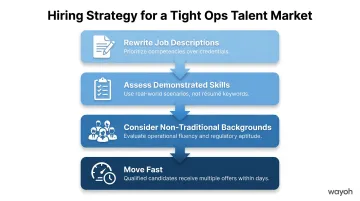
What this means for hiring teams:
- Rewrite job descriptions to emphasize competencies over credentials
- Assess demonstrated skills through real-world scenarios, not just résumé keywords
- Consider non-traditional backgrounds where operational fluency and regulatory aptitude exist
- Move faster on qualified candidates who will receive multiple offers within days
Banks that post and wait lose ops talent to competitors who move in days, not weeks. Wayoh has placed 500+ professionals across community, commercial, and digital banking—reaching experienced candidates through direct outreach before they ever appear on a job board.
What's Driving These Banking Operations Hiring Trends
The convergence of regulatory complexity, market infrastructure upgrades, and technology transformation has created structural, not cyclical, demand for operations talent. These hiring pressures won't ease when the business cycle shifts—they're baked into the operating environment banks now navigate.
Regulatory intensity is mandating headcount. Increasing federal and state scrutiny around BSA/AML compliance, payments security, third-party risk, and operational resilience is forcing banks to staff functions they previously treated as shared-service add-ons. Three regulatory actions are shaping current staffing requirements directly:
- Interagency Guidance on Third-Party Risk Management (OCC, FDIC, Federal Reserve, 2023) — consolidates lifecycle expectations across planning, due diligence, ongoing monitoring, and governance
- Federal Reserve's Community Bank Third-Party Risk Management Guide (May 2024) — sets practical governance and staffing expectations for community banks overseeing third-party relationships
- Interagency Paper on Sound Practices to Strengthen Operational Resilience (2024) — emphasizes disruption tolerance, scenario analysis, essential personnel identification, and board oversight of critical operations
Technology transformation requires experienced hands. Core banking modernization, real-time payment integrations, and AI rollouts all require operations professionals to manage transitions, configure workflows, and catch exceptions automated systems create. This drives both project-based and permanent hiring demand. The Treasury RFI on AI risks (June 2024) specifically notes human capital shortages in AI risk identification, and OCC Bulletin 2026-13 signals more AI-focused model risk expectations ahead—both pointing toward additional ops and compliance headcount needs.
Competitive dynamics raise the stakes. The rise of digital banks, fintech lenders, and embedded finance players has pressured traditional banks to modernize faster with leaner teams—making every operations hire higher-stakes and less forgiving of a slow search process.
Talent pipeline gap persists. Entry-level ops hiring slowed during periods of banking consolidation and automation investment, creating a structural gap in mid-career ops professionals—the candidates most in demand now. This gap will persist for several years regardless of market conditions, making proactive pipeline-building essential.
Future Signals for Banking Operations Jobs and What Banking Firms Should Do Now
The next one to three years will bring continued demand growth in compliance-ops hybrid roles, new subspecialties tied to AI governance and model risk operations, and increasing differentiation between institutions that have built durable ops talent pipelines and those still reacting to vacancies.
Workforce projections signal sustained growth across the roles driving this shift:
- The BLS projects compliance officers at 3% growth (2024–34) and financial examiners at 19% growth (2024–34) — the latter reflecting intensifying supervisory and regulatory exam demands
- The Treasury RFI on AI risks signals institutional need for staff who can manage model explainability, bias review, and vendor concentration risk
- Robert Half identifies AI Governance and Risk Officers as emerging finance roles — a trend already crossing into bank operations and compliance hiring
Proactive hiring strategies separate winners from laggards:
- Maintain relationships with qualified candidates before roles are approved — pipelines built in advance fill faster and with less compromise
- Evaluate competency in BSA/AML workflows, automation platforms, and payment systems rather than defaulting to credential proxies
- Revisit compensation bands to reflect current market rates — compliance-linked and tech-fluent ops specialists consistently command premiums
- Work with specialist firms: Wayoh has placed 500+ operations and compliance professionals over a decade, with personal candidate relationships that job boards can't replicate
Prioritize building these roles now:
- Operations professionals with AML/compliance fluency who bridge back-office processing and regulatory frameworks
- Treasury and payments operations specialists familiar with real-time rails (FedNow, RTP) and T+1 settlement workflows
- Operations analysts with automation platform experience who can configure, audit, and manage AI-driven workflows
Banks that treat operations hiring as a strategic function — investing in relationships, skills-first assessment, and specialist recruitment partners — will build the operational resilience regulators expect and the processing capacity growth demands. The institutions hiring deliberately today won't be scrambling to catch up when the next compliance cycle hits.
Frequently Asked Questions
What is the future of banking operations?
Banking operations is evolving toward greater specialization, with compliance-linked, technology-adjacent, and real-time payments ops roles growing fastest. The function is becoming more strategic as regulatory demands and automation complexity increase, shifting from transactional processing to system oversight and regulatory governance.
Is an operations specialist a good job?
Banking operations provides a stable career with defined progression paths and strong job security. Compensation ranges from $40,000–$80,000+ at entry and mid-level, exceeding $100,000 at senior levels. Regulatory functions are non-negotiable for banks, which insulates these roles from economic volatility.
Is operations specialist an entry level job?
Some banking operations roles are accessible to recent graduates with relevant degrees in finance, business, or accounting. However, compliance-linked and treasury ops roles typically require prior banking or financial services experience, making them mid-career entry points rather than true entry-level positions.
What skills are most in demand for banking operations specialists in 2026?
BSA/AML knowledge, payment platform familiarity, and regulatory compliance fluency are the top hiring drivers. Proficiency with banking software, settlement workflows, and automation platforms commands compensation premiums above standard ranges.
How much do banking operations specialists typically earn?
Salaries vary significantly by specialization and institution size. Entry-level roles start around $40,000-$55,000, mid-level specialists earn $60,000-$90,000, and senior operations managers exceed $100,000. Higher compensation is common in financial hubs like New York and San Francisco and for compliance-linked subspecialties.
Why is it so hard to hire banking operations specialists today?
Several pressures converge at once: low finance-sector unemployment, an aging mid-career talent pipeline, and compensation expectations rising as fintechs and private credit firms compete for the same candidates. On top of that, the skills gap between traditional ops training and the technical and regulatory fluency banks now require means qualified candidates are scarce — and search timelines of 60–90+ days are increasingly common.